Quick answer: To launch your brand on TikTok Shop, first confirm the brand is ready (margin room, stock, trademark and fast fulfillment), choose one to three hero products, verify the shop and your brand authorization, then build listings, pricing and a branded storefront. Seed those products with creators before you switch on GMV Max ads, and judge the first 90 days on contribution after ads, creator output and fulfillment health, not GMV alone.
TikTok Shop has become a serious sales channel for consumer brands. Tubefilter, citing Momentum Works and Tabcut, reported that TikTok Shop’s global gross merchandise value (GMV, the total value of orders placed) reached $50.3 billion in the first half of 2026, up 92% year over year, with US GMV at $11.8 billion at the time of the report.
For a brand that already sells through its own website, Shopify, Amazon or retail, the real question is whether you can launch there in a way that protects your margins, stock and reputation.
This playbook is written for brand owners and marketing leads. It follows the 14 step process we use to launch and grow brands on TikTok Shop, grouped into four phases: plan, build, activate and grow. Platform rules below were checked against TikTok’s own Seller University and Business Help Center pages in October 2026. TikTok updates its policies often, so treat Seller Center as the final word before you act.
How TikTok Shop differs from your other channels
On Amazon or Google, shoppers arrive with a query and compare listings. On TikTok, most shoppers arrive because a video interrupted their scroll. That changes what drives sales.
- Content is the storefront. A product with no videos has almost no reach, however good the listing is.
- Creators are the sales force. Affiliate creators earn a commission on the orders their videos and LIVE sessions drive, so recruiting and briefing them is a core sales task.
- Ads amplify what already works. TikTok’s ad engine for Shop pulls from the same pool of organic, creator and LIVE content, so ads scale proof rather than create it.
- Operations are visible. Shipping speed, cancellations and reviews feed directly into how much TikTok shows your products.
Treat TikTok Shop as a content and creator channel with a checkout attached, not as one more marketplace feed.
Is your brand ready for TikTok Shop?
Before you open Seller Center, run a short readiness check. Brands that skip it usually find the gaps after launch, when fixing them costs more.
| Area | Ready looks like | Warning sign |
|---|---|---|
| Products | At least one product that shows a clear result or reaction on camera within seconds | The value only comes through in long explanations |
| Margin | Room for the referral fee, creator commission and ad spend after landed cost and fulfillment | Contribution per order is thin before any ad spend |
| Brand rights | A registered US trademark, or written authorization from the trademark owner | A trademark still pending, or unclear ownership |
| Inventory | Stock you can set aside for TikTok orders, plus a reorder plan | Inventory shared across channels with no allocation |
| Fulfillment | A warehouse, 3PL or Fulfilled by TikTok plan that ships within two business days | Orders batched weekly or shipped by hand at peak |
| Content | Someone who can brief creators and approve videos every week | No owner for creator relationships |
| Budget | A launch budget for samples, content and ads, plus a reserve | Ad spend expected to find sales without creator videos |
If the warning signs are in margin, brand rights or fulfillment, fix those first. Thin content capacity can be solved with partners. A product that loses money on every order cannot.
The 14 step launch process at a glance
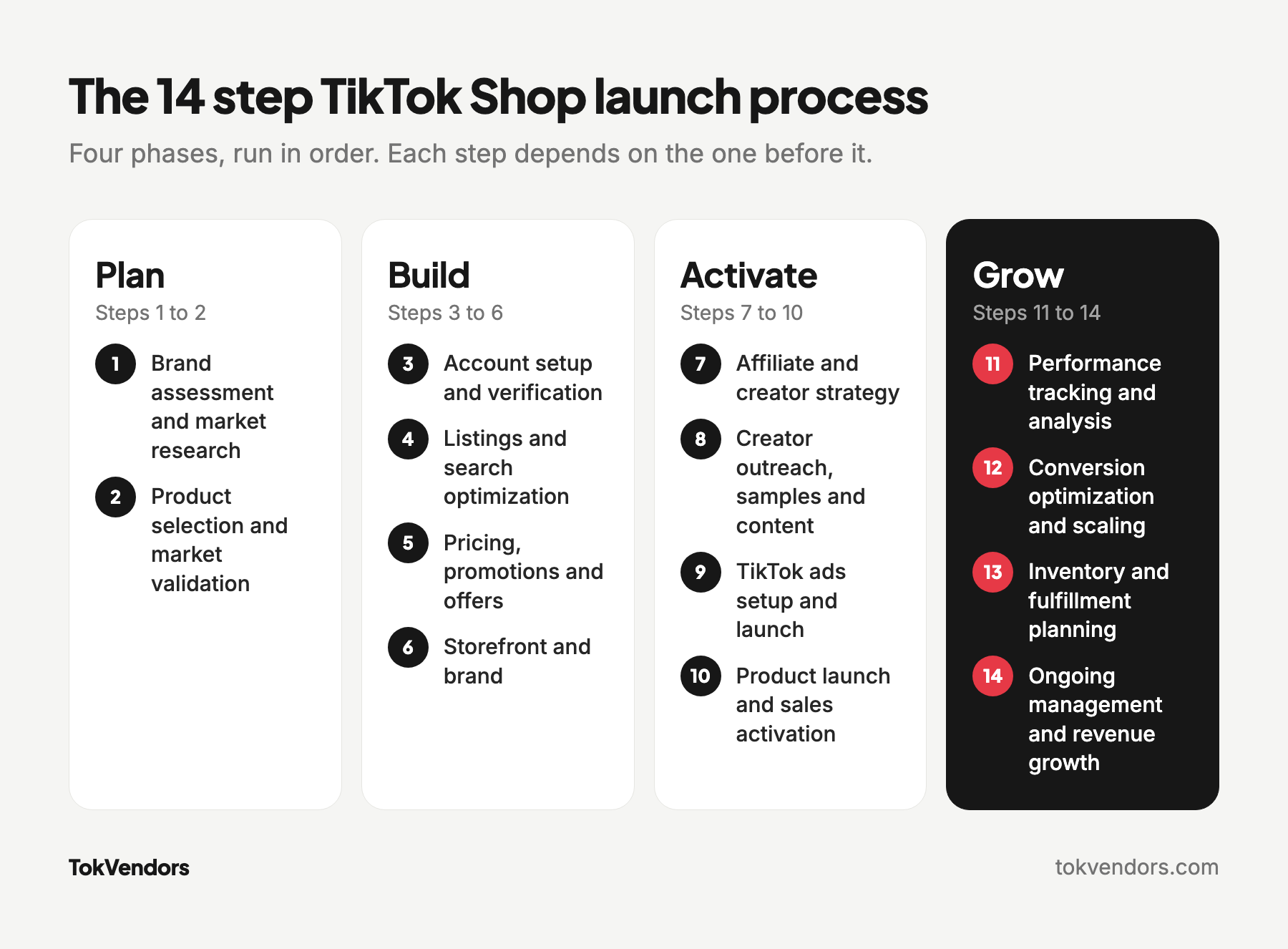
Here is the full sequence. The order matters: each step depends on the one before it, and many failed launches come from running steps 9 and 10 before steps 7 and 8 are working.
- Brand Assessment & Market Research
- Product Selection & TikTok Shop Market Validation
- TikTok Shop Account Setup & Verification
- Product Listing Creation & SEO Optimization
- Pricing, Promotions & Offer Strategy
- Storefront Setup & Brand Optimization
- Affiliate & Creator Marketing Strategy
- Creator Outreach, Sample Distribution & Content Generation
- TikTok Ads Setup & Campaign Launch
- Product Launch & Sales Activation
- Performance Tracking & Data Analysis
- Conversion Rate Optimization & Growth Scaling
- Inventory Planning & Order Fulfillment Coordination
- Ongoing Store Management & Revenue Growth
Steps 1 and 2 are planning, steps 3 to 6 build the shop, steps 7 to 10 activate sales, and steps 11 to 14 run and grow the business. If you want the same process as a week by week task list with an owner for every item, use our TikTok Shop launch checklist.
Phase 1: Plan
Step 1: Brand Assessment & Market Research
Start with what you already know. Your website analytics, Amazon reviews and customer service inbox show which products people love, which claims resonate and which complaints repeat. Pull your top sellers by revenue and by margin, your main return reasons, and the questions customers ask before they buy.
Then study your category on TikTok. Search your product type in the app and the Shop tab, and note which competitors sell, at what prices, with which creators and hooks. Comments under the best videos show the objections your content must answer.
Finally, decide how TikTok Shop sits next to your other channels. Agree in advance on price parity, which products you will offer, how stock is allocated, and who inside the business owns the channel. A launch without an internal owner tends to stall at the first approval, stock or creative question.
Step 2: Product Selection & TikTok Shop Market Validation
Most brands should not launch their full catalog. Lead with one to three hero products and expand once you know what sells. Good launch products usually share five traits:
- Visual proof. The result, texture, transformation or reaction is visible on camera.
- An impulse friendly price. Shoppers often buy from a video in seconds, so the price has to make sense without research.
- Margin room. After landed cost, fulfillment and the referral fee, there is enough left to pay creators and ads.
- Stock depth. You can absorb a spike if a video takes off.
- Low compliance risk. No claims you cannot support and no category approvals you cannot get.
Validate demand with TikTok’s own data. In Seller Center, the Product Opportunities tool shows trending keywords, popular hashtags and categories where demand is high and competition is low. TikTok notes that the tool is a reference for product selection rather than a sourcing service, which suits brands well: use it to check whether your existing products match what shoppers search for, and which keywords belong in your listings.
Then run a margin test on every candidate. Start from the selling price, subtract landed cost, fulfillment, the referral fee and an expected creator commission, and see what is left. That figure, contribution per order before ads, sets your breakeven ROI: the selling price divided by contribution per order. The higher that number, the more efficient your ads must be just to break even, so products with a very high breakeven ROI often work better as bundles or second wave products.
Phase 2: Build
Step 3: TikTok Shop Account Setup & Verification
Register your business in TikTok Shop Seller Center. For US corporations and partnerships, TikTok’s Seller University lists these documents:
- Government ID for the representative, such as a US passport, driver’s license or state ID
- Details of each ultimate beneficial owner, meaning anyone who directly or indirectly owns at least 25% of the company
- Proof of business: an IRS notice such as a 147C, 252C or CP 575 showing the legal business name, address and EIN
- Tax forms, which TikTok says can follow later but must be submitted once you earn $2,000 to keep selling and receive payment
- Proof of address or a letter of authorization for the person acting for the business, if requested
Details must match exactly across every document and the registration form. Mismatched names and addresses are a common cause of delays.
Brand authorization. Products that carry a registered trademark may need brand authorization before you can list them, and TikTok says it may remove products listed without it. Requests go through the Qualification Center in Seller Center. Trademark owners enter their USPTO registration number, and TikTok emails a verification code to the trademark’s official contact, often the attorney on record, which must be entered within 10 days. If the trademark is held by a parent or holding company rather than the entity that owns the shop, you need a letter of authorization from the owner on its letterhead, naming your seller entity, the brand, the country and the product category. TikTok asks sellers not to apply with trademarks still pending at the USPTO.
Shopify brands. TikTok’s guide for Shopify sellers describes connecting through the TikTok sales channel app, choosing which products to sync, mapping them to TikTok Shop categories and mapping your warehouses. TikTok reviews products before they go live.
Access for your team. Keep the shop under your own business and give staff or partners role based access. TikTok’s Seller Center roles include Advertising Manager and Affiliate Manager, while bank accounts, tax information and user management stay visible only to the shop owner’s account.
New shop probation. Every new US shop starts in TikTok’s New Shop Probation Program. TikTok’s page (updated August 2026) lists daily order caps of 50, 100 and 200 orders for the Beginner, Standard and Premium tiers, and listing limits of 100, 200 and 1,000 products. There is no fixed timeline: shops graduate as they meet fulfillment, listing and customer service standards consistently. Plan your launch volume around those caps.
Step 4: Product Listing Creation & SEO Optimization
The listing is where a video click becomes a sale, and where Shop search decides whether you appear at all. TikTok’s SEO guidance suggests a title structure of brand, product, application, type and main features, written clearly and without keyword stuffing. It recommends researching terms in Seller Center under Analytics, in the Shop tab search keyword rankings, and working them naturally into titles and descriptions.
TikTok’s Product Listing Policy (updated September 2026) sets the rules:
- Up to 9 square images of at least 600 x 600 pixels, with a pure white background on the main image and no added logos, text, borders or watermarks
- No false, exaggerated or unproven claims, and no labels such as “Best Seller”
- One listing per product, with sizes, colors and styles grouped as variations
- Prices in line with category standards
Bring your best website or Amazon copy, but rewrite it for a phone screen, and check that every claim is one you could support with evidence, because creators will repeat what your listing says.
Step 5: Pricing, Promotions & Offer Strategy
Price for the whole cost stack, not just the platform fee. TikTok’s published US table lists a 6% referral fee for most categories, calculated on the customer payment plus any platform discount, minus tax, and including shipping paid by the customer. Rates vary by category and TikTok can update them, so confirm yours on your own settlement statements.
On top of the referral fee sit creator commissions, fulfillment, returns and ad spend. A simple example: a $35 product with an $8 landed cost, $6 fulfillment, a 6% referral fee ($2.10) and a 15% creator commission ($5.25) contributes about $13.65 per affiliate order before ads and returns, so its breakeven ROI is about 2.6. Our guide to TikTok Shop launch cost builds full launch budgets on assumptions like these.
Launch offers should drive trial without training buyers to wait for discounts. TikTok’s promotion tools include product discounts, flash sales, coupons and Buy More Save More, which applies a discount at a spend or quantity threshold and can target new, existing or repeat customers. Bundles and multipacks are often a better launch lever than deep discounts because they raise order value and give creators a stronger offer to talk about. Note that TikTok may not show strike through pricing on new listings until it can verify the list price.
Step 6: Storefront Setup & Brand Optimization
Your shop page is the brand’s home inside TikTok. TikTok describes it as an in app shop you can customize with your branded design. Use it the way you would use a homepage: a clear logo and description, hero products first, then collections such as bestsellers, bundles and new arrivals.
Connect the brand’s official TikTok account to the shop so your own videos and LIVE sessions carry shopping links. TikTok’s Shop Recognition Program awards an Official Shop badge to brand owners who complete trademark verification, with requirements that include a shop logo, at least five active listings in stock and no counterfeit or other serious violations. Each brand can have only one Official Shop.
TikTok’s guide to notable brands says it looks for several verifiable signals, including a registered trademark, a working website tied to the brand name, official social accounts and established sales channels. Keep your website’s About and Contact pages consistent with what you submit, and renew any authorization documents before they expire.
Want this launch run for you?
TokVendors launches and grows TikTok Shops for brands that already have products, from verification and listings to creators, GMV Max, LIVE and fulfillment.
Phase 3: Activate
Step 7: Affiliate & Creator Marketing Strategy
Creators are the engine of most TikTok Shop launches. Their videos drive organic sales, and the same videos feed your ads later. Decide the structure before you send a single sample.
TikTok’s Affiliate Center offers two main collaboration types. An open collaboration makes your products visible to all creators, with an option to approve who joins. A target collaboration invites specific creators at a rate you set for them, and TikTok says target rates always override the open rate. Commission can be set from 1% to 80%, and timing matters: TikTok says changes to target rates take effect after 5 days and changes to open rates after 30 days. Target collaborations also support a flat fee option for video content, paid once the video is approved.
For orientation, Short Form Nation’s 2026 data puts most open collaboration rates at 10% to 15% and targeted rates typically at 18% to 30%, and suggests a launch open rate of 15% to 20%. It also suggests a separate Shop Ads commission, the rate paid when an affiliate video runs as an ad, of about 5% to 8%. These are benchmarks, not rules: set your open rate from your own margin test, then agree custom rates with the creators who prove they sell.
A simple launch structure works for most brands:
- An open collaboration at a competitive rate on your hero products, with approval switched on so you control who gets samples
- Target collaborations at a higher rate for a shortlist of creators whose audience and recent sales fit your category
- Flat fees for a few proven creators, paid per video on top of commission, when you need committed deliverables by a date
Step 8: Creator Outreach, Sample Distribution & Content Generation
Outreach is a volume task with a quality filter. TikTok lets sellers send target invitations in batches of 50 creators and up to 1,000 in 24 hours, but the creators who sell are the ones whose audience already buys your kind of product. Vet by recent sales in your category, audience fit and content quality, not follower count.
Samples are the fuel. Approve sample requests against clear criteria, ship quickly and follow up within a week of delivery. Track every sample from request to posted video to sales, so you know which creators and hooks earn a second sample.
Give every creator a short brief: the problem, the moment of proof to show on camera, the claims they may and may not make, and the disclosure rules. The FTC’s guidance for influencers says free products count as a material connection, and that disclosures in a video should appear in the video itself, not only in the caption. Creators are responsible for their own disclosures, but your brief should make the rule impossible to miss.
Post your own videos from the brand account too, and plan LIVE sessions once you have product proof and a host who knows the range. TikTok Shop’s quality rules for LIVE, as reported by PPC Land in June 2026, require real time verbal interaction (no AI voices or playback narration) and limit still images to half the screen.
Step 9: TikTok Ads Setup & Campaign Launch
Since July 2025, GMV Max has been the only supported campaign type for new TikTok Shop ads, according to Enrich Labs. TikTok describes GMV Max as bringing together organic videos, paid ads, affiliate posts and LIVE content, with the seller setting an ROI target and a budget and the system directing spend toward what performs.
Three rules keep a launch campaign healthy:
- Content first. GMV Max can only scale what it has. TikTok’s best practices say more videos with product anchors mean greater GMV potential, and recommend including authorized affiliate videos, which often perform better.
- Set the target from your margin. Your target ROI should sit above your breakeven ROI. Without history, TikTok suggests starting from its recommended ROI or a slightly lower target.
- Change slowly. TikTok recommends keeping each ROI setting for at least three full days before adjusting, because frequent changes interrupt learning.
For a launch push, TikTok’s Max delivery option adds budget to selected products or livestreams with no ROI constraint, and TikTok suggests new advertisers run it for 5 to 7 days with a set daily budget. Use it deliberately: it buys reach and data, not efficiency. If you sell on LIVE, LIVE GMV Max optimizes traffic into your livestream using both short videos and the LIVE itself.
TikTok also offers ROI protection. From February 25, 2026, eligible campaigns can receive ad credits when ROI falls below 90% of the daily target on days with more than 20 orders, with exclusions that include Max delivery and days when the campaign was paused or products were edited. Most new shops will not reach 20 daily orders at first, so do not build the launch plan around it.
Step 10: Product Launch & Sales Activation
Launch is a sequence, not a single day. A pattern that works for many brands:
- Soft open. Listings live, storefront built, test orders shipped end to end.
- Seeding wave. First samples delivered, first creator videos posting, the brand account posting most days.
- Ads on. GMV Max switched on once a pool of videos exists, with a target above breakeven.
- Activation moments. A launch offer, a LIVE session or a creator flash sale that concentrates demand into a few days.
Watch the probation order cap during this phase, and make sure fulfillment and customer service are ready before you push volume.
Phase 4: Grow
Step 11: Performance Tracking & Data Analysis
GMV is the headline, not the scoreboard. Track whether the channel makes money and whether its engines are healthy. The metrics table further down lists what to review and how often. The key habits are separating organic, affiliate, ad and LIVE sales, and comparing ROI with your own breakeven rather than someone else’s benchmark.
Step 12: Conversion Rate Optimization & Growth Scaling
Once sales are steady, lift the conversion rate before you raise spend. Rewrite titles with the search terms that bring traffic, replace weak images, add variations or bundles, and answer the most common questions from comments inside the listing.
Keep reviews healthy. TikTok tracks a shop negative review rate over the last 60 days and says many poor ratings can lower a shop’s search rank. It also prohibits incentives for reviews and inserts in packaging that ask for positive ones, so the only reliable route is a product and delivery experience that earns them.
Scaling then comes from more creators, more content, larger budgets and a wider catalog, broadly in that order. We cover each lever in our guide on how to scale a brand on TikTok Shop.
Step 13: Inventory Planning & Order Fulfillment Coordination
Fulfillment metrics decide whether TikTok keeps showing your products. Under TikTok’s Fulfillment Policy (September 2026), regular orders must be marked in transit within 2 business days, and the policy sets these standards:
| Metric | Standard |
|---|---|
| Valid tracking rate | 95% or higher |
| Late dispatch rate | 4% or lower recommended; enforcement possible above 10% |
| On time delivery rate | 80% or higher |
| Seller fault cancellation rate | 2.5% or lower |
Many brands use Fulfilled by TikTok (FBT) for TikTok orders. TikTok says FBT handles storage, packing and shipping, that eligible products get a Free 3 Day Delivery tag, and that the first 60 days of storage for each inbound shipment are free. A 3PL that already ships your Shopify or Amazon orders can also work, as long as it meets the deadlines. Either way, forecast from a trailing average of daily sales rather than your best day, and set a reorder trigger tied to your supplier’s lead time.
Step 14: Ongoing Store Management & Revenue Growth
After launch, the work becomes a weekly and monthly rhythm: new creators recruited, content refreshed, campaigns tuned, promotions planned around TikTok’s sales calendar, stock replenished and customer messages answered quickly.
Protect account health above everything else. TikTok’s Account Health Rating starts every seller at 200 points, deducts points for violations and performance issues, and applies restrictions at 150, 100 and 50 points, including blocks on new listings and new mega campaigns for 7, 14 and 28 days. At zero points, the account may be permanently deactivated. Points expire after 180 days.
Performance also shapes cash flow. TikTok’s settlement policy places new and probation shops on an introductory settlement period, holds reserves for 30 days after delivery to cover returns, and reviews settlement tiers monthly using shop performance, advising sellers to aim for a Shop Performance Score above 4.0.
Your first 90 days
Timelines vary with product, category and creator response, so treat this as a planning shape, not a promise.
| Weeks | Focus | Steps | What you should have by the end |
|---|---|---|---|
| 1 to 2 | Plan and verify | 1 to 3 | Hero products chosen, margin test done, shop and brand authorization submitted |
| 3 to 4 | Build the shop | 4 to 6 | Listings approved, pricing and launch offer set, storefront live, test orders shipped |
| 5 to 6 | Seed creators | 7 to 8 | Collaborations live, first samples delivered, first creator videos posted |
| 7 to 8 | Ads on and launch | 9 to 10 | GMV Max running with a target above breakeven, first launch moment or LIVE complete |
| 9 to 10 | Read the data | 11 to 12 | A weekly report, listing fixes, a second sample wave aimed at proven creator profiles |
| 11 to 13 | Stabilize and plan growth | 13 to 14 | A reorder plan, fulfillment metrics in range, a decision on what to scale next |
AmpliSell’s 2026 buyer’s guide advises against judging TikTok Shop performance on 30 day windows alone, and that matches what we see: creator content compounds, and the first month mostly produces learning. Plan to read results at the end of the full 90 days.
The metrics that matter
| Metric | What it tells you | How often |
|---|---|---|
| GMV by source (organic, affiliate, ads, LIVE) | Which engine is driving sales | Weekly |
| Contribution after ads | Whether the channel makes money | Weekly |
| ROI against target and breakeven | Whether ad spend is efficient | Daily glance, weekly decision |
| Samples sent, videos posted, creators with sales | Health of the creator pipeline | Weekly |
| Product page conversion rate | Strength of the listing and offer | Weekly |
| Refund rate and negative review rate | Product or expectation problems | Weekly |
| Late dispatch, on time delivery, cancellations | Fulfillment risk | Daily during launch |
| Account Health Rating points | Platform risk | Weekly |
| Days of stock cover | Risk of selling out mid momentum | Weekly |
Common launch mistakes
- Launching the whole catalog. Samples and content spread thin, and no product gets enough proof.
- Ads before content. GMV Max with few creator videos has little to work with and teaches you little.
- Pricing from the referral fee alone. Commissions, fulfillment, returns and ads together cost far more than the platform fee.
- Ignoring probation caps. A video that takes off against a 50 order daily cap leaves demand unmet and creators frustrated.
- Slow shipping. Late dispatch costs points, visibility and settlement speed.
- Changing the target ROI every day. TikTok recommends at least three full days between changes.
- Judging the channel at 30 days. Most launches need the full 90 day window before the data is worth acting on.
Launch in house or with a partner?
You can run every step above in house if your team can manage creators, ads, listings and fulfillment at the same time. Many brands bring in help for the launch because the first 90 days need all of those skills at once.
If you are weighing an agency, read our guide on how to choose a TikTok Shop agency, including the red flags to watch for, and our breakdown of TikTok Shop agency pricing so you can test any fee against your margins before you sign.
Our TikTok Shop Brand Launch & Growth program runs this 14 step process for brands that already have products. You own the shop, the data and the brand; we do the work and report on it every week. Results depend on your product, category and market, so we will not promise numbers, but we will show you the plan, the costs and how we measure progress. Pricing is quoted per store on the strategy call. Book a free strategy call to see how the plan would look for your brand.
Frequently asked questions
How long does it take to launch a brand on TikTok Shop?
Verification and listing approval times depend on your documents, brand authorization and category, so start them early. A full launch usually runs about 90 days from setup to a clear read on results, because creator content builds over time. Timelines vary by product, category and creator response, so avoid judging the channel on the first 30 days.
Do I need a registered trademark to sell my brand on TikTok Shop?
Products that carry a registered trademark may need brand authorization, which TikTok handles through the Qualification Center in Seller Center. Trademark owners verify with their USPTO registration number, and TikTok asks sellers not to apply with trademarks that are still pending. The Official Shop badge also requires trademark verification.
Can I sell on TikTok Shop and Amazon at the same time?
Yes. Many brands sell on TikTok Shop alongside their website, Amazon and retail partners. Set clear rules for price parity, stock allocation and which offers are TikTok only, so a promotion or a viral week on TikTok does not disrupt your other channels.
When should a brand start TikTok Shop ads?
Start GMV Max once you have a pool of creator and brand videos, not before. GMV Max is the only supported campaign type for new TikTok Shop ads and works from the content available, so ads switched on without videos have little to scale. Set the target ROI above your breakeven ROI and hold each setting for at least three full days.
How much does it cost to launch a brand on TikTok Shop?
TikTok’s main platform charge is a referral fee on each order, listed at 6% for most categories in its published US table. Launch costs come from samples, creator fees, content, ad spend and fulfillment setup. Our illustrative 90 day budgets run from about $5,100 for a focused launch to about $40,600 for a standard one, before agency fees, based on stated assumptions.
Sources
- Led by U.S. sales, TikTok Shop is on track to hit $100 billion of gross merchandise value in 2026, Tubefilter, August 6, 2026
- Beginner’s Guide: What documents do I need to register as a Corporation or Partnership?, TikTok Shop US Academy, October 9, 2026
- Requirements for Brand Authorization, TikTok Shop US Academy, October 9, 2026
- TikTok for Shopify: 5 Steps to Start a Successful Store, TikTok Shop US Academy, August 19, 2025
- Roles and permissions in Seller Center, TikTok Business Help Center, August 2025
- New Shop Probation Program Requirements, TikTok Shop US Academy, August 10, 2026
- How to Use Product Opportunities, TikTok Shop US Academy, August 25, 2026
- SEO and Discovery: Tips to Boost Visibility and Sales, TikTok Shop US Academy, April 30, 2026
- Product Listing Policy, TikTok Shop US Academy, September 1, 2026
- TikTok Shop Referral Fees in 2024 by Category, TikTok Shop US Academy, page dated October 8, 2026
- Buy More Save More and BXGY, TikTok Shop US Academy, October 19, 2026
- How to Use Seller Flash Sale, TikTok Shop US Academy, April 24, 2026
- TikTok Shop seller page, TikTok For Business, accessed October 2026
- Shop Recognition Program, TikTok Shop US Academy, August 25, 2026
- A Seller’s Guide to “notable brands” on TikTok Shop, TikTok Shop US Academy, May 29, 2026
- Setting Up Affiliate Collaborations, TikTok Shop US Academy, July 16, 2026
- About target collaborations in Seller Center, TikTok Business Help Center, August 2025
- TikTok Shop Affiliate Commission Rates: What Brands Should Offer (2026 Data), Short Form Nation, May 8, 2026
- Disclosures 101 for Social Media Influencers, Federal Trade Commission, November 2019
- TikTok Shop’s quality rules ban AI voices and still images from LIVEs, PPC Land, June 8, 2026
- TikTok Shop Ads: Complete Guide 2026, Enrich Labs, 2026
- GMV Max: Your TikTok Shop growth engine, TikTok For Business, May 13, 2026
- Best practices for Product GMV Max, TikTok Business Help Center, June 2026
- About Max delivery optimization for GMV Max, TikTok Business Help Center, March 2026
- About LIVE GMV Max, TikTok Business Help Center, September 2026
- About ROI protection for GMV Max campaigns, TikTok Business Help Center, September 2026
- Customer Reviews and Why They Matter, TikTok Shop US Academy, October 9, 2026
- Fulfillment Policy, TikTok Shop US Academy, September 28, 2026
- Fulfilled by TikTok (FBT), TikTok Shop US Academy, August 6, 2026
- Account Health Rating (AHR) Requirements, TikTok Shop US Academy, October 9, 2026
- Dynamic Settlement and Reserve Policy, TikTok Shop US Academy, July 31, 2026
- 7 Best TikTok Shop Agencies in 2026: A Buyer’s Guide, AmpliSell, July 24, 2026