Quick answer: To start a TikTok Shop in the US, register in TikTok Shop Seller Center as an individual or a business, pass identity and document verification, set up your warehouse, shipping and bank details, then list a small set of compliant products. From there, recruit affiliate creators, launch a GMV Max campaign at a target ROI you can afford, and follow a 90 day plan built around content volume and clean fulfillment.
TikTok Shop is no longer an experiment for most consumer brands. Tubefilter, citing Momentum Works and Tabcut, reported that TikTok Shop’s global gross merchandise value (GMV, the total value of orders placed) reached $50.3 billion in the first half of 2026, up 92% year over year, with the US at $11.8 billion at the time of the report.
Growth at that pace attracts sellers, and it also raises the bar. The shops that do well in 2026 tend to get the boring parts right first: a clean registration, healthy fulfillment metrics, honest listings, and a steady supply of creator videos. This guide walks through every step in the order we would do it, with the numbers that matter at each stage.
Every platform rule below was checked against TikTok Shop’s own Seller University pages in October 2026. TikTok changes policies often, so treat Seller Center as the final word before you act.
Before you register: decide what you will launch and how
The most expensive mistake brands make happens before registration: opening a shop without a clear launch plan. The products you lead with decide your sample budget, your margins, and which documents TikTok will ask for later.
Most brands should not list their whole catalog on day one. Lead with a few products that demonstrate well on video and leave room for fees, commission and ads, then decide how TikTok Shop will sit next to your website, Amazon listings and retail partners on price and stock. We cover that plan in depth in our guide to launching your brand on TikTok Shop.
Write down three things before you open Seller Center:
- Your first category. Some categories, such as beauty and personal care or shelf stable food, require qualification before you can list. Dietary supplements are invite only in the US.
- Your landed cost per unit. This is product cost plus freight, duties and packaging, delivered to your warehouse.
- Your target selling price. TikTok buyers often purchase on impulse from a video, so the price has to make sense in a few seconds.
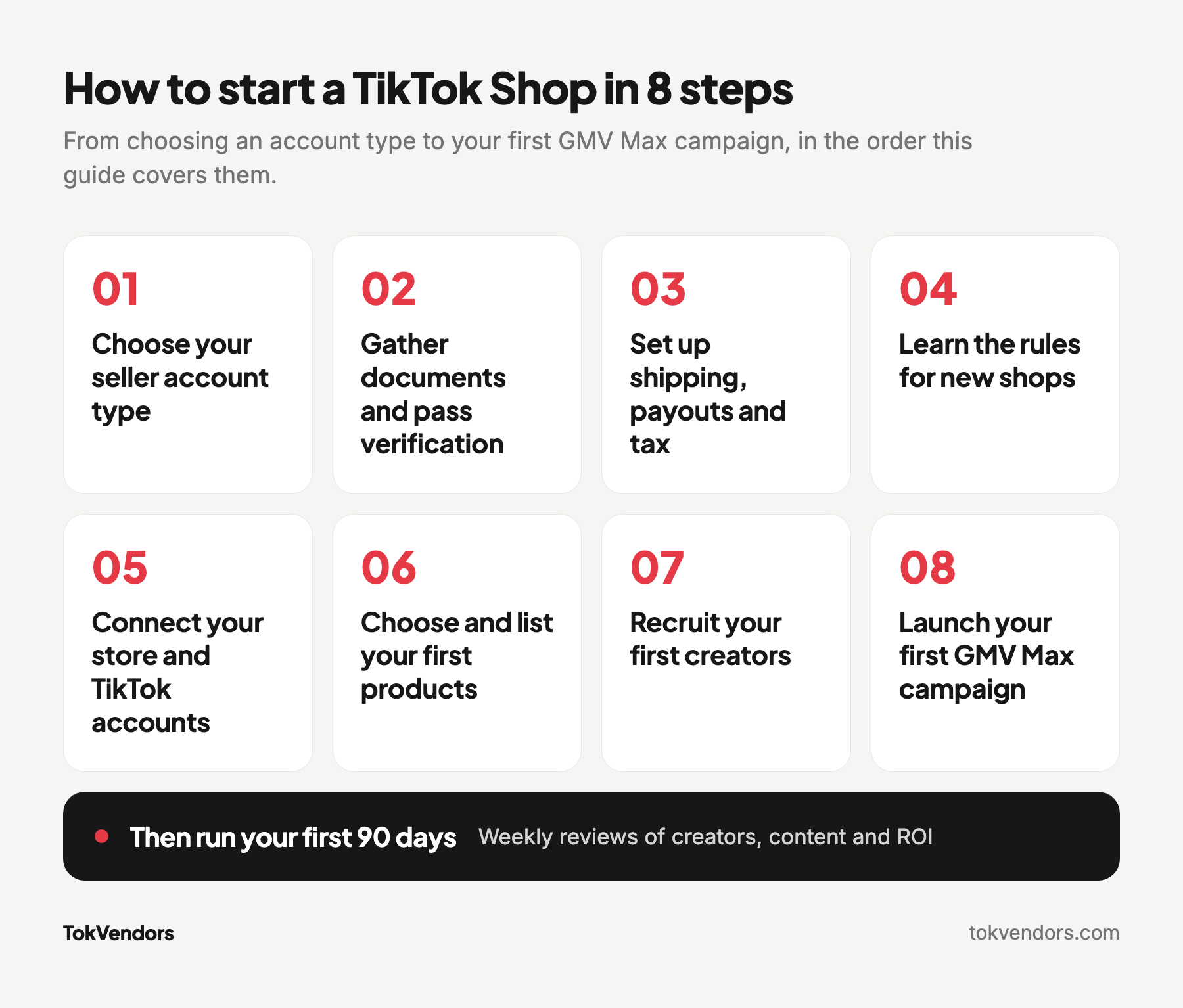
Step 1: Choose the right seller account type
TikTok Shop US offers individual and business registration. Business sellers then choose a structure such as sole proprietorship, corporation or partnership. Printify’s 2026 registration guide notes that the account type cannot be changed after registration, so treat this choice as permanent.
| Account type | Who it suits | Key requirements |
|---|---|---|
| Individual | Solo sellers testing products under their own name | US residency, age 18+, US government ID, last 4 digits of SSN or an ITIN, bank account in your legal name, W 9 |
| Sole proprietorship | One owner operating under a business name | Personal ID plus an IRS issued document showing the legal business name and EIN, if requested |
| Corporation or partnership (including LLCs) | Brands and companies planning to scale or hire | EIN, IRS issued proof of business, a US business representative, beneficial owners with 25% or more equity, business bank account |
If your brand already operates as a company, apply as that entity rather than as an individual. Business shops also get more flexibility early on. For example, a business shop on probation can link one marketing creator account, while an individual shop on probation cannot.
Step 2: Gather your documents and pass verification
Verification is where most first time applications stall. TikTok’s US registration guides list the following, as of October 2026.
Eligibility basics
- You must be at least 18 and reside in the US.
- Your phone number and email cannot already be used for another shop.
- Politicians and political party affiliated accounts cannot become sellers.
Documents TikTok accepts
- Government ID: US passport or passport card, US driver’s license, state ID, or permanent resident card. Other ID types are rejected.
- Proof of address, if requested: a utility bill, bank or credit card statement, or insurance policy. The address must match what you typed into the form.
- Proof of business, if requested: IRS 147C, IRS 252C, or IRS CP 575 (versions A, B, E or G), showing the legal business name, address, EIN and notice date.
- Tax form: a W 9. You can start selling before submitting tax documents, but TikTok requires them once you earn $2,000 in order to keep selling and receive payment.
Files must be under 10 MB in JPG, PNG, JPEG or PDF format. TikTok rejects expired documents, paper IDs, cropped images, and photos of a computer or phone screen. IRS website screenshots, SS 4 applications, tax returns and e file confirmations are not accepted as proof of business.
How the review screen works
During registration, Seller Center checks your fields as you go. A green checkmark means a field is verified; a yellow caution symbol means it needs fixing. Your legal name, date of birth, address and SSN must all show as verified, or you must upload supporting documents, before you can submit.
Pro tip: Printify’s guide reports that editable IRS confirmation PDFs can be read as altered documents. Printing the letter, scanning the printout, and uploading the scan avoids that problem.
Mismatched names and addresses cause more rejections than anything else. We cover every document, the most common rejection reasons and how to fix each one in our full guide to TikTok Shop seller requirements.
Step 3: Set up your warehouse, shipping, payouts and tax
Once your application is submitted, finish the operational setup. TikTok’s Seller Center setup guide walks through a warehouse or pickup address, a return address, terms acceptance, document verification, and bank linking. The bank account name must match your registered legal name or company name exactly.
Choose a shipping model
TikTok’s US logistics guide, last updated September 2026, describes these options:
| Option | Who handles shipping | Availability | Worth knowing |
|---|---|---|---|
| Seller Shipping | You, through your own carrier contract | Select sellers only | You must upload valid tracking; Valid Tracking Rate must stay at 95% or higher |
| Upgraded TikTok Shipping | You pack; TikTok provides labels and manages carriers | Most sellers | TikTok covers lost or damaged parcels; fees are based on actual or volumetric weight |
| Fulfilled by TikTok (FBT) | TikTok stores, packs and ships | Apply in Seller Center | Earns a free 3 day delivery badge with no minimum spend; exempt from late dispatch metrics |
| Collections by TikTok (CBT) | Pickup add on to TikTok Shipping | Shops averaging over 50 daily orders in eligible zip codes | Additional savings on standard shipping rates |
Most new shops start on TikTok Shipping and move high velocity products into FBT once demand is proven. Whatever you choose, know the clock: regular orders must be marked In Transit within 2 business days, and orders without tracking can be auto cancelled after 5 business days.
Understand when you get paid
New shops are placed on an introductory settlement period, which is the slowest payout tier. TikTok also holds a portion of earnings from each delivered order in reserve for 30 days from the delivery date. Plan your cash flow so that inventory, samples and ad spend do not depend on fast payouts in month one.
Set up customer service and returns before orders arrive
Buyer requests run on short timers, and missed timers are decided for you. TikTok’s US cancellation, return and refund policy, last updated September 2026, sets these defaults:
- Return window: 30 calendar days from delivery by default. Qualified sellers can choose other windows, such as 45 or 90 days.
- Return and refund requests: you have 4 business days to respond before TikTok may auto approve.
- Refund only requests: 2 business days for items at $100 or less, and 4 business days above $100.
- Cancellation requests: if you do not act within 24 hours, TikTok may approve the cancellation.
- Low priced items: refunds without a return are automatically enabled for items priced from $0.01 to $10.00.
Assign one person to check buyer messages and after sales requests every day, including weekends during launches. Response speed also feeds your Shop Performance Score (SPS), a separate 0 to 5 rating that reflects product satisfaction, fulfillment and customer service over the last 90 days and influences payout speed.
Step 4: Learn the rules that govern new shops
Three systems shape your first months: probation, account health and fees. Understanding them before your first sale prevents most avoidable setbacks.
Probation
Every new US shop starts in TikTok’s New Shop Probation Program. TikTok describes it as a growth phase, not a punishment. Limits rise as you complete tasks and fulfill orders well.
| Probation tier | Daily order limit | Product listing limit |
|---|---|---|
| Beginner | 50 | 100 |
| Standard | 100 | 200 |
| Premium | 200 | 1,000 |
| Pro | No probation order cap | Not capped by probation |
There is no fixed timeline for graduating. Progress depends on reliable fulfillment, accurate listings, responsive customer service and passing the probation quiz. When you hit your daily order limit, your products show as out of stock, so pace promotions accordingly.
Account Health Rating
Since July 2026, the Account Health Rating (AHR) has replaced the old violation points system. Every seller starts at 200 points on a 0 to 1,000 scale covering the last 180 days. Falling to 150, 100 or 50 points blocks new listings and mega campaign enrollment for 7, 14 or 28 days, and an account at 0 may be permanently deactivated. Read our guide to TikTok Shop account health for the violation categories, fulfillment thresholds and appeal process.
Fees
TikTok’s US category fee table, last updated October 2026, lists a 6% referral fee for most categories, 5% for certain jewelry and preowned items, and a 20% refund administration fee on refunded referral fees, capped at $5 per SKU. TikTok can update these rates, so confirm yours on your own settlement statements. Our breakdown of TikTok Shop fees includes a full category table and a worked margin example.
Want the setup done right the first time?
TokVendors handles registration, verification, shipping and catalog setup so your shop launches clean and stays compliant.
Step 5: Connect your store and link your TikTok accounts
If you already sell on Shopify, you can register and manage your TikTok Shop through the TikTok for Shopify app. Shopify then becomes the source of truth for products, prices and inventory, and TikTok orders sync back into Shopify. Our step by step guide shows how to connect Shopify to TikTok Shop and fix the most common sync errors.
If you are deciding where TikTok Shop fits next to Amazon or your own site, our comparison of TikTok Shop vs Amazon vs Shopify covers traffic, fees and control side by side.
Link creator accounts to your shop
A shop sells through TikTok accounts that are bound to it. An official account carries the same name as your shop. Marketing accounts are additional creator accounts, such as a founder’s account or a staff host, that can post shoppable content for the shop.
| Shop status | Official accounts | Marketing accounts |
|---|---|---|
| Individual shop on probation | 1 | 0 |
| Business shop on probation | 1 | 1 |
| Graduated, no severe violations | 1 | 4 |
Bound accounts must belong to people who are at least 18 and based in the US. There is no minimum follower count to bind, but your own content alone will rarely produce enough volume. That is why creators matter so much in Step 7.
Step 6: Choose and list your first products
Start with a short catalog. Five to fifteen products is enough to learn what converts without spreading samples, inventory and creative too thin. Beginner tier shops are capped at 100 listings anyway.
What makes a strong first product
- A visible result or reaction. TikTok sells through video, so the benefit should be easy to show in the first three seconds.
- Room for fees, commission and ads. After the referral fee, an affiliate commission and ad spend, you still need contribution margin left. Products with a landed cost under 30% of the selling price give you more room to work with.
- A clean compliance path. Avoid products that need claims you cannot substantiate, and check whether your category requires qualification in the Qualification Center.
- Stable supply. Out of stock cancellations count against your seller fault cancellation rate, which must stay at or below 2.5%.
Our pillar guide to choosing your winning TikTok Shop products lays out a scoring framework for deciding what to launch first, covering demand signals, margin tests and creator fit.
Listing essentials
- Titles: TikTok’s own Shopify guidance recommends titles that are descriptive rather than inspirational. Lead with what the product is, then key attributes such as size, quantity or material.
- Images: clear, well lit photos on a clean background, plus lifestyle images that show scale and use.
- Weight and dimensions: required, and they drive shipping cost. Wrong dimensions lead to shipping fee adjustments later.
- Attributes and category: miscategorization and incomplete information are listed under listing quality violations in the AHR policy.
- Brand: you can only select brands you are authorized for. Have proof that you own your brand, or are authorized to sell it, ready before listing.
If you would rather not build the catalog yourself, our TikTok Shop setup service covers registration, verification, shipping configuration and launch ready listings.
Step 7: Recruit your first creators
Affiliate creators are the engine of most TikTok Shops. They make videos featuring your product, tag it, and earn a commission when viewers buy. You manage all of this in the Affiliate Center inside Seller Center.
Open vs target collaborations
| Collaboration | How it works | Best use |
|---|---|---|
| Open collaboration | Your products are visible to all eligible creators, who can add them and start promoting. You can require approval. | Broad reach and passive discovery by new creators |
| Target collaboration | You invite specific creators, up to 50 per batch, with a set commission, optional free samples and deliverables | Hand picked creators who fit your audience |
Commission rates can be set from 1% to 80%. If a product sits in both an open and a target collaboration, the target rate applies, so TikTok recommends setting target rates higher. Timing matters: new target commissions take effect 5 days after you edit them, while open collaboration changes take 30 days.
A practical first month creator plan
- Turn on an open collaboration for every launch product at a commission you can sustain after fees and ads.
- Build a list of 100 to 200 creators who already post in your category and whose videos show products being used, not just held.
- Send target invitations in batches with a slightly higher commission and a free sample offer.
- Set sample approval rules so samples go to creators likely to post, then follow up within a week of delivery.
- Track which creators post, which videos generate orders, and which hooks repeat across winners.
Make your own videos too
Creator content takes weeks to arrive, because samples have to ship and creators post on their own schedule. Fill the gap with videos from your official account. They do not need studio production; they need to show the product clearly and give a reason to buy.
- Problem and fix: show the frustration first, then the product solving it in one continuous shot.
- Demonstration: pour it, stretch it, apply it, assemble it. Let viewers see texture, size and speed.
- Comparison: your product next to the common alternative, with an honest, specific difference.
- Unboxing and first use: what arrives, how it is packed, what it looks like in hand.
- Answering comments: reply to real questions with short videos. These often convert because they address a doubt directly.
Keep claims factual and provable. Your own videos and your creators’ videos are both subject to TikTok’s content and product policies, and violations can affect your shop.
Expect a minority of sampled creators to post, and a smaller share to drive sales. That is normal. The goal of month one is to find the handful of creators and angles worth investing in. Our complete guide to TikTok Shop affiliate marketing covers plan types, samples and managing creators at scale.
Step 8: Launch your first GMV Max campaign
Paid ads on TikTok Shop now run through GMV Max. Since July 2025, GMV Max has been the only supported campaign type for new TikTok Shop ads. According to TikTok, GMV Max combines organic videos, paid ads, affiliate posts and LIVE content, and automatically directs spend toward the content that performs best. You set a budget and a target ROI, and the system optimizes toward it.
Work out your breakeven ROI first
ROI in GMV Max means gross revenue divided by ad spend. A target ROI of 4 means you want $4 of GMV for every $1 spent. Before you pick a target, calculate the lowest ROI at which an ad driven order still breaks even.
Here is a simple illustrative example:
- Selling price: $30.00
- Landed product cost: $7.50
- Referral fee at 6%: $1.80
- Fulfillment: $4.28
- Affiliate commission at 15%: $4.50
- Contribution before ads: $30.00 minus $18.08, which is $11.92
Breakeven ROI is the price divided by the contribution before ads: $30.00 divided by $11.92, or about 2.5. Below that, each ad driven order loses money. A target near 3 to 4 leaves room for returns, samples and overhead. These numbers are hypothetical; use your own costs.
Launch settings that keep you out of trouble
- Wait for content. TikTok says GMV Max has no creative minimum, but in practice the campaign can only scale what exists. Launch once you have a few organic or affiliate videos with real engagement.
- Start near breakeven, then tighten. A target set too high often stops the campaign from spending at all.
- Change one thing at a time. Adjust either budget or target ROI, then give the campaign time to settle.
- Know ROI protection. Since February 25, 2026, TikTok issues ad credits when campaign ROI falls below 90% of the daily target on days with more than 20 orders, subject to exclusions such as days with manual target changes on Product campaigns.
Our complete GMV Max guide goes deeper on Product vs LIVE campaigns, budgets, creative and reporting.
Your first 90 days: a practical plan
The first 90 days are about proving that a product, a few creators and one campaign can work together profitably. Here is the sequence we follow, with the main metric to watch at each stage.
| Window | Focus | Key actions | Metric to watch |
|---|---|---|---|
| Days 1 to 14 | Foundation | Finish verification, shipping, bank and tax; list 5 to 15 products; bind your official account; pass the probation quiz | Listings approved without review failures |
| Days 15 to 30 | Seeding | Open collaboration on all products; target invitations to 100 to 200 creators; ship samples; post 1 to 2 brand videos per day | Creator videos posted per week |
| Days 31 to 60 | First paid push | Launch Product GMV Max on the product with the best organic signal; set target ROI near breakeven plus a buffer; double down on creators who convert | Actual ROI vs target, and contribution margin per order |
| Days 61 to 90 | Stabilize and expand | Raise budgets on campaigns hitting target; add a second hero product; test LIVE sessions; consider FBT for fast movers | Account Health Rating, late dispatch rate, repeat creator output |
Budget for the launch, not just the registration
Registration costs nothing, which leads many sellers to underfund the launch. The real outlays are inventory, samples, content and ad testing. Here is a hypothetical way to size the sample budget alone, using the same product as the ROI example above:
- 150 creator samples at a $7.50 landed cost and roughly $4.28 to pick, pack and ship each one: about $1,767
- Replacement samples and reshipments for lost or damaged parcels: set aside an extra 10%, about $177
- Total sample budget for the seeding phase: about $1,944
Add inventory deep enough to survive a video that takes off, plus a GMV Max test budget you can afford to spend while the system learns. Size each line to your own product and costs. If any single line would strain your cash, scale the launch down rather than skipping a step.
What a healthy shop looks like at day 90
There is no standard revenue figure for day 90, because results depend on product, price, category and execution. Instead, look for operating signals: a steady flow of new creator videos each week, at least one product with a GMV Max campaign spending near its target ROI, an Account Health Rating at or above the starting 200 points, fulfillment metrics inside TikTok’s thresholds, and a clear picture of contribution margin per order after every fee. A shop with those signals has something to scale. A shop without them needs fixing before more spend.
Weekly operating rhythm
- Daily: ship every order within the 2 business day window, answer buyer messages, check the Seller Center inbox and email for violation notices.
- Twice a week: review new creator videos, approve samples, and authorize strong affiliate videos for ads.
- Weekly: review GMV Max results against target ROI, check AHR and fulfillment metrics, and plan the next batch of creator outreach.
- Monthly: reconcile settlement statements against your own margin model, including referral fees, commissions, refunds and shipping adjustments.
Mistakes that slow new shops down
- Registering with mismatched details. A missing suite number or a bank account in a different name can mean rejection and delay.
- Listing too many products at once. A wide catalog spreads samples and creative thin, and you run into probation listing limits.
- Pricing without the full cost stack. Referral fees, commission, shipping, returns and ads together can consume more than half of the selling price.
- Running ads before content exists. GMV Max amplifies videos. With weak or no videos, spend stalls or converts poorly.
- Making unsupported product claims. Health, weight loss or before and after claims are a fast route to listing removals and AHR deductions.
- Overselling. Out of stock cancellations count toward the 2.5% seller fault cancellation limit. Keep a stock buffer, especially when a video takes off.
- Ignoring the inbox. Some violations offer only a short window to appeal or correct before enforcement takes effect.
Launch checklist
- Launch products and first category chosen
- Entity, EIN and business bank account in matching names (business sellers)
- ID, proof of address and IRS documents scanned cleanly, under 10 MB
- Seller Center application submitted with all fields verified
- Warehouse and return addresses set, shipping option selected
- Bank account linked and W 9 submitted
- Category qualification approved where required
- 5 to 15 listings live with accurate weights, dimensions and attributes
- Official TikTok account bound to the shop
- Open collaboration live and first target invitations sent
- Breakeven ROI calculated for each hero product
- First GMV Max campaign planned for when content is ready
- Daily fulfillment and inbox routine assigned to a named person
The bottom line
Starting a TikTok Shop is straightforward on paper and demanding in practice. Registration takes days; building the creator pipeline, content volume and fulfillment discipline that keep a shop healthy takes months. Sellers who treat the first 90 days as a structured test, with clear margins and clean operations, give themselves the best chance of building something durable. Results vary by product, category and execution, and no plan removes that risk.
If you would like experienced operators to handle the setup and the first 90 days with you, book a free strategy call with TokVendors and we will walk through your products, channels and launch plan.
Frequently asked questions
How much does it cost to open a TikTok Shop?
Opening a TikTok Shop in the US has no listing or monthly subscription fee. You pay a referral fee on each completed order, which TikTok’s category table lists at 6% for most categories, plus shipping or fulfillment, any affiliate commissions and any ad spend you choose. The real launch costs are samples, content, ad testing and the stock you set aside for TikTok orders, so budget for those before you register.
How long does TikTok Shop approval take?
TikTok does not publish a fixed review time. Seller guides commonly report a few business days for clean applications, with longer reviews when documents are missing, mismatched or when your category needs qualification. Submitting documents that match your registration details exactly is the best way to avoid delays.
Do I need followers to start a TikTok Shop?
No. TikTok’s creator bind rules state there is no minimum follower requirement to bind an official or marketing account to your shop. Followers help your own content reach people, but most new shops rely on affiliate creators and GMV Max to generate early sales.
Can I start a TikTok Shop without an LLC?
Yes. US residents aged 18 or older can register as an individual using a US government ID, the last four digits of an SSN or an ITIN, and a bank account in their legal name. If you plan to scale, registering as a business entity from the start avoids having to set up a new shop later, since the account type generally cannot be changed after registration.
Can I sell on TikTok Shop from outside the US?
TikTok’s US individual registration requires that you reside in the US. US business registration requires a US registered entity with a US based business representative and a valid US ID, and beneficial owners can verify with a nonUS passport. Requirements change, so confirm the current rules in Seller Center before applying.
Sources
- Led by U.S. sales, TikTok Shop is on track to hit $100 billion of gross merchandise value in 2026, Tubefilter, August 6, 2026
- Beginner’s Guide: What documents do I need to register as an Individual Seller or Sole Proprietorship?, TikTok Shop Seller University (US), Last updated October 9, 2026
- Beginner’s Guide: What documents do I need to register as a Corporation or Partnership?, TikTok Shop Seller University (US), Last updated October 9, 2026
- How to register as an Individual, TikTok Shop Seller University (US), Last updated May 13, 2026
- TikTok Shop registration: A 2026 POD seller’s guide, Printify, Updated September 11, 2026
- Set Up TikTok Shop Using Seller Center, TikTok For Business Help Center, Last updated June 2026
- Logistics & Fulfillment: Shipping Options, Policies, and Best Practices, TikTok Shop Seller University (US), Last updated September 9, 2026
- Fulfillment Policy, TikTok Shop Seller University (US), Last updated September 28, 2026
- Dynamic Settlement and Reserve Policy, TikTok Shop Seller University (US), July 31, 2026
- Customer Order Cancellation, Return, and Refund Policy, TikTok Shop Seller University (US), Last updated September 28, 2026
- New Shop Probation Program Requirements, TikTok Shop Seller University (US), Last updated August 10, 2026
- Account Health Rating (AHR) Requirements, TikTok Shop Seller University (US), Last updated October 9, 2026
- TikTok Shop blocks new listings and campaigns when seller AHR hits 150, PPC Land, June 29, 2026
- TikTok Shop Referral Fees in 2024 by Category, TikTok Shop Seller University (US), Last updated October 8, 2026
- TikTok Shop Referral Fee Updates (2024), TikTok Shop Seller University (US), Last updated May 8, 2025
- TikTok Shop Fees, Hubfluence, 2026
- Creator Bind Eligibility and Requirements, TikTok Shop Seller University (US), Last updated September 30, 2026
- Restricted Products Policy, TikTok Shop Seller University (US), Last updated October 9, 2026
- Seller Fault Cancellation Rate Requirements, TikTok Shop Seller University (US), Last updated August 6, 2026
- TikTok for Shopify: 5 Steps to Start a Successful Store, TikTok Shop Seller University (US), Last updated August 19, 2025
- Setting Up Affiliate Collaborations, TikTok Shop Seller University (US), Last updated July 16, 2026
- GMV Max: Your TikTok Shop growth engine, TikTok For Business Blog, May 13, 2026
- TikTok Shop Ads: Complete Guide 2026, Enrich Labs, 2026