Quick answer: The TikTok Shop affiliate program lets sellers pay creators a commission on the sales their videos and LIVEs drive. You run it from the Affiliate Center in Seller Center: open collaborations for reach, target collaborations for hand picked creators, then samples, briefs, ad authorization and weekly measurement to make it profitable.
Most sales on TikTok Shop start with a creator. A buyer watches someone they trust use a product, taps the tag and checks out without leaving the app. The affiliate program is the system that makes this repeatable: you set commissions, creators pick up your products, and you pay only on attributed sales.
That simple model hides a lot of operating work. Commission rates have to fit your margin. Samples need rules so they don’t disappear into accounts that never post. Content has to stay inside TikTok’s claim and disclosure policies, and the best videos need to be authorized for ads. This guide walks through each piece the way an operator sets it up for a new shop.
Platform rules change often. The specifics below come from TikTok help pages and the other sources listed at the end, checked in October 2026. Confirm details in your own Seller Center before you change settings.
How the TikTok Shop affiliate program works
Affiliate creators are TikTok users approved to promote other sellers’ products. When they post a shoppable video or host a LIVE with your product tagged, each attributed order pays them the commission you set. You choose the rate; TikTok tracks the order and handles the payout.
For a seller, the program does three jobs at once:
- Distribution. Each creator brings an audience you would otherwise have to buy with ads.
- Content. Every affiliate video is creative you didn’t have to produce, and the strong ones can run as ads.
- Feedback. The hooks, prices and bundles creators choose, and which ones convert, tell you a lot about your listing and offer.
Video is where much of the discovery happens. Momentum Works and Tabcut data, reported by Tubefilter, put video at about 40% of TikTok Shop GMV (gross merchandise value, total sales before fees and refunds) in the first half of 2026, with the Shop Tab just over half and LIVE at about 8%. For most sellers, affiliate creators are the most practical way to get products into that video feed at volume.
Who can become an affiliate creator
Creator eligibility is TikTok’s call, not yours, but it shapes who you can work with. Recent reports of the US policy describe affiliate creators as needing to be at least 18, based in the US, identity verified and above 1,000 followers. New affiliate creators under 5,000 followers go through a 30 day pilot program with caps on shoppable videos and LIVEs and no access to campaigns. The exact caps have been reported differently over time, so treat the creator’s own Creator Center as the source of truth.
In practice, a small creator who looks perfect for your product may not be able to post as often as you would like during their first month. Factor that into launch timing.
New brand vs known brand: how the program differs
The mechanics are the same for every brand, but the strategy depends on how well buyers already know you.
If your brand is new to TikTok, every affiliate video builds awareness from zero. The job is more seeding, more creator education on what the product is, and patience while the first videos find their audience. Direct brands with healthy margins usually have room to lead with a generous commission.
If your brand is already known through retail, Amazon or a loyal DTC following, creators can sell on existing trust, and some may already post about you. Retailers or other sellers may also list your products on TikTok Shop, so your commission, sample policy, stock reliability and shipping speed are what bring creators to your official shop. Retail pricing commitments can limit discounts, which makes the margin math in the next sections even more important. Keep claims consistent with what your packaging and other channels already say.
Inside the Affiliate Center
The Affiliate Center is the affiliate section of Seller Center. Menu names shift between updates, but the core tools have been stable:
| Tool | What it does | When you use it |
|---|---|---|
| Open collaboration | Makes products available to any eligible creator at a commission you set, from 1% to 80% of GMV per order, either manually or as an optimized rate | From day one, for every product your margin can support |
| Target collaboration | Invites specific creators to promote specific products at a custom rate, with optional samples, content requests and a flat fee option | For creators you have vetted and want to prioritize |
| Find creators | Creator search plus recommendations, such as creators who promoted similar products or whose followers bought or viewed similar products | Building a prospect list |
| Sample settings | Offer free samples per product, or refund creators once they make their first sale | Seeding new products |
| Shop Ads commission | A separate rate for orders that come from ads using affiliate posts | When affiliate videos will run as ads |
| Boost orders with GMV Max | Adds products in an open collaboration to an automated GMV Max campaign at a suggested or custom ROI target | When affiliate demand is ready to scale with ads |
Two settings deserve attention early. First, you can switch on auto adding so new products join your open collaboration as soon as they are listed. That is convenient, but risky if a new product has thinner margins, so many operators leave it off and add products by hand. Second, open collaboration setup lets you add up to 50 products at a time, which makes it easy to group products by margin band and set a rate per group instead of one rate for the whole shop.
Open vs target collaboration: choosing plan types
Think of the two plan types as two layers of the same program.
An open collaboration, often called an open plan, is a public offer. Any eligible creator can find the product in the marketplace and start promoting it, and you can require approval if you want control over who joins. It gives you breadth: many creators testing your product at a standard rate.
A target collaboration, often called a targeted plan, is a private offer. You invite named creators, one at a time or in bulk, to promote selected products for a period you choose. You can pay a higher commission, include free samples, request certain content types and ask for submitted videos to be authorized for ads.
| Factor | Open collaboration | Target collaboration |
|---|---|---|
| Who can join | Any eligible creator (approval optional) | Only creators you invite |
| Commission | 1% to 80% of GMV per order, by product, product group or whole shop | 1% to 80% of GMV per order, set per product in the invitation |
| Fee model | Commission | Commission only, or a flat fee paid through TikTok Shop (video only) |
| Samples | Free sample or refund on first sale, per product | Same options, offered in the invitation |
| Best for | Discovery and volume | Proven or high fit creators |
| Main risk | Low fit creators and uneven content | Time spent on outreach and management |
When a product sits in both, a creator earns one rate, and the target rate always wins. TikTok’s own guidance is to set target rates higher than open rates. A common structure is an open rate your margin can carry at scale, plus target rates a few points higher for creators who have already shown they can sell.
Setting commissions your margin can carry
Commission is a cost of sale, like the referral fee or shipping. The right rate is the highest one your unit economics can support while leaving room for ads and profit. It is not the rate a competitor happens to show.
Work it out per product:
- Start from the selling price after any discount you plan to run.
- Subtract product cost, packaging, fulfillment and any shipping you pay.
- Subtract the TikTok Shop referral fee for your category (check the current rate in Seller Center).
- Decide the minimum profit per order you want to keep, including an allowance for ads if you will run them.
- What is left is your maximum affordable commission. Your open rate should sit comfortably below it, and your best target rates can approach it.
An illustration with made up numbers: a $30 product with $9 landed cost, $5 for fulfillment and shipping, and TikTok’s listed 6% referral fee ($1.80) leaves $14.20. If you want to keep $6 per order, you can afford up to $8.20 in commission, about 27%. An open rate of 15% ($4.50) leaves room for custom target rates of 20% to 25% for proven creators.
Third party benchmarks give a rough sense of the market. A 2026 Short Form Nation guide puts standard open rates around 12% to 15% for beauty and personal care, 10% to 13% for fashion and 5% to 8% for electronics, with targeted rates several points higher. Those figures are compiled from practitioner sources rather than TikTok data, and other guides publish different ranges, so use them as a sense check rather than a target. Our guide to TikTok Shop commission rates and negotiation covers rate ladders, flat fees and deal terms in depth.
The Shop Ads commission
If affiliate videos will run as ads, there is a second rate to set. The Shop Ads commission is a separate rate, from 1% to 80%, that applies when an order comes from an ad using an affiliate post. With a 10% standard rate and a 5% Shop Ads rate, an organic order pays the creator 10% and an ad driven order pays 5%. If you don’t set a Shop Ads rate, ad driven orders pay the standard rate.
A few rules apply. TikTok’s help page describes the feature as available to invited sellers. In open collaborations, the Shop Ads rate cannot be lower than 30% of the standard rate (Mexico and Brazil excepted), so a 10% standard rate means a 3% floor. A Shop Ads rate set in a target collaboration overrides the open one for that creator. Tell creators about the Shop Ads rate before you ask for ad authorization, because surprises here damage relationships.
Want a second opinion on your affiliate setup?
On a free strategy call we review your commission structure, sample rules and creator mix, and show where your affiliate program is leaking margin.
When a deal goes beyond a standard commission, put the terms in writing. Our guide to TikTok Shop creator contracts covers deliverables, usage rights and payment terms.
Free samples: seeding with rules
Samples are how most affiliate programs get their first wave of content. They are also where most programs lose money quietly, because a sample that never becomes a video is pure cost.
TikTok gives you two options per product: offer a free sample, or refund the creator once they make their first sale. Free samples get more creators moving. Refund on first sale protects you from creators who never post, at the cost of fewer takers. Many shops use both: free samples for target creators they have vetted, refund on sale for open requests from creators they don’t know yet.
Set approval criteria before requests arrive:
- Category fit: the creator already posts in your niche.
- Recent shoppable activity: product tagged videos in the last 30 days.
- Sales evidence: GMV history in comparable products.
- Content quality: clear audio, the product shown in use, real comments from real viewers.
- Follow through: if they have had samples from you before, did they post?
Then follow up on a schedule. Sample requests run on fixed windows for review, shipping and posting; a Hubfluence guide published in September 2026 reports that sellers have seven days to review a request before it cancels automatically. Check the current windows in Seller Center and build reminders around them. Our free samples seeding strategy covers approval scorecards, follow up timing and how to measure return on seeding.
Recruiting creators who actually sell
Open collaborations bring creators to you. Target collaborations require you to go out and find them. The difference between a program that grows and one that stalls is usually the quality of that second list.
Good prospects share three traits: they post in your category, they have sold comparable products recently, and their audience looks like your buyer. Follower count is a weak signal on its own. A creator with 20,000 followers who sells every day can outperform a 500,000 follower account that rarely tags products.
Where to look:
- Seller Center’s Find creators page, especially recommendations for creators who promoted similar products.
- Creator videos tagged to the top competing products in your category.
- TikTok search for your product keywords and problem phrases, focused on recent videos.
- Your own comments and tagged posts, where existing customers already make content.
- Third party analytics tools that estimate creator GMV by category.
Our step by step guide to finding and recruiting TikTok Shop creators includes a vetting scorecard and outreach scripts. If you would rather hand off discovery, vetting and deal making entirely, that is the focus of our Creator Research & Deals service.
What good creators look for in a seller
Recruiting is a two way sale. The creators you most want get many invitations every week, and they choose sellers who make their job easy. In practice, these matter as much as the rate:
- A product that converts. Creators check reviews, ratings and whether other videos on the product are selling. Fix your listing before you recruit.
- Reliable stock and shipping. Nothing ends a partnership faster than a viral video pointing to an out of stock listing or late deliveries that turn into bad comments.
- Fast, specific communication. A named contact who answers within a day and sends useful notes, not a generic inbox.
- Clear, stable terms. Rates, Shop Ads rates and sample rules that don’t change without notice.
- Something new to post. New products, bundles and offers give active creators a reason to make another video.
Briefing creators and staying compliant
A brief is the cheapest performance lever you have. It cuts revision time, gets the product shown properly and keeps claims inside the rules. Keep it to one page: the product, the buyer, the problem it solves, two or three hook ideas, must show moments, claims allowed and banned, offer details and disclosure requirements.
Three sets of rules apply to almost every affiliate video:
- Disclosure. TikTok’s Branded Content Policy, effective August 31, 2026, treats content made in exchange for payment, gifted products, affiliate commission or promo codes as branded content. Creators must turn on the commercial content disclosure setting, and the product must be clear without viewers visiting a profile or clicking a link. The FTC’s guidance for influencers adds that video disclosures belong in the video itself, not only the caption, and should be repeated during livestreams.
- Claims. TikTok Shop’s content policy, as reported in June 2026, requires promotional content to be accurate and consistent with the product. Unsupported or scientifically impossible claims, and content implying extreme physical transformations, can be removed or penalized. The FTC is equally direct: creators can’t make claims that need proof the brand doesn’t have, such as a product treating a health condition.
- Quality. TikTok Shop’s US requirements for shoppable videos ask for real world footage with visible people and at least three seconds of dynamic visuals, and they prohibit product page screenshots in content.
Some categories carry extra restrictions. The Branded Content Policy lists vitamin supplements and over the counter medicines as restricted and weight loss products as prohibited, among others. If you sell anywhere near those categories, read the policy before you brief anyone. Our creator brief templates include a copyable one page brief and a claims checklist.
Paying beyond commission: flat fees and retainers
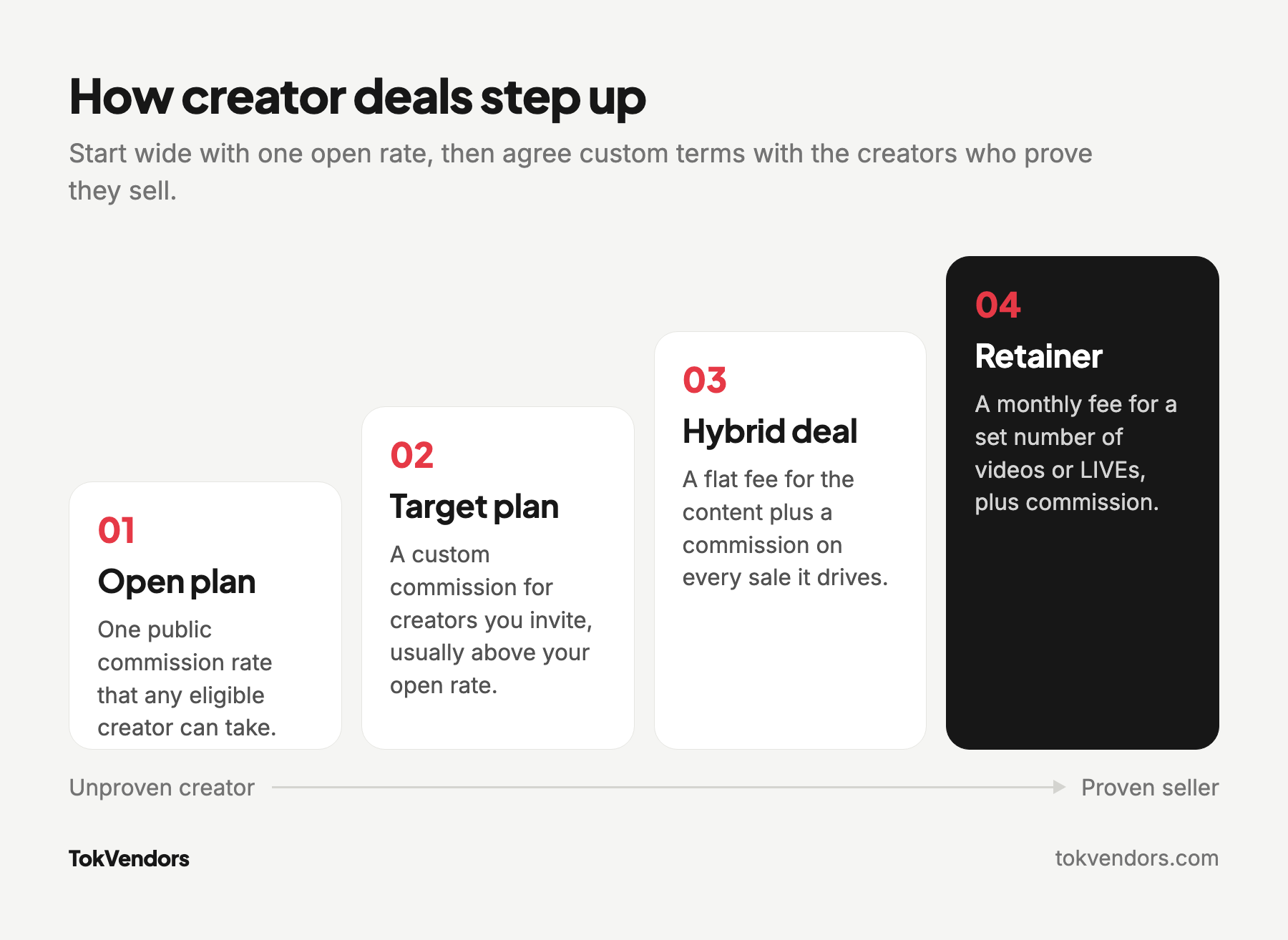
Commission only deals work for most creators, most of the time. You pay only when a sale happens, and the creator decides whether your product is worth their effort. As your program matures, a few other structures earn a place:
- Flat fee through a target collaboration. TikTok’s target collaboration offers a flat fee option: you pay TikTok Shop a fixed amount, and the creator is paid after you or the platform approve their video. It applies to video only. Commission only collaborations, by contrast, need no video review.
- Flat fee plus commission. Useful for creators whose content you want for ads, or who are in high demand. The fee covers production and a committed posting date; the commission keeps them motivated to sell.
- Monthly retainer. For a small number of core creators who post several times a month and agree to ad usage. Agree deliverables, dates and usage rights in a written contract.
- Performance bonuses. A higher rate or a one off bonus once a creator crosses an order threshold in a set period. This rewards results without paying for promises.
The rule of thumb: pay fixed money for things you can verify (a video delivered, a LIVE hosted, usage rights granted), and pay commission for sales. Never pay a flat fee for “reach” alone, and never agree to a deal that depends on a creator promising sales figures.
Turning affiliate content into ads with GMV Max
Affiliate content and paid ads now work as one system on TikTok Shop. GMV Max became the only campaign type for new TikTok Shop ads from July 2025. It draws on organic videos, paid ads, affiliate posts and LIVE content, and it optimizes toward a target ROI you set. TikTok’s May 2026 overview adds that GMV Max now counts costs beyond ad spend, such as affiliate commissions, coupons and referral fees, when it reports ROI.
That has three practical consequences for your affiliate program:
- Volume of good videos matters. GMV Max can only scale the creative it has. A program producing 30 usable affiliate videos a month gives the system far more to test than one producing five.
- Authorization is part of the deal. Using a creator’s post in ads requires their permission. With Spark Ads, the creator shares an authorization code, and its duration can be customized. In target collaborations you can also request that submitted videos be authorized for ads. Agree on this up front, in writing.
- Your Shop Ads commission affects both sides. A lower Shop Ads rate improves ad efficiency but cuts what creators earn on ad driven orders. Set it deliberately and explain it.
Our complete GMV Max guide covers ROI targets, budgets and how campaigns use creator content.
LIVE: affiliates who sell in real time
Some affiliate creators are mainly LIVE sellers. They run long streams, demo products one after another and drive orders in bursts. LIVE is a smaller share of total GMV than video, but for products that need demonstration or benefit from a time limited offer, a strong LIVE affiliate can be one of your best partners.
Target collaborations let you set up flash sales for LIVE events, but only when inviting a single creator with LIVE access, not in bulk. Agree the offer, stock levels and product order with the creator before the stream. Our guide to TikTok LIVE shopping covers formats, hosts and a full run of show.
Managing the program at scale
A program with 10 creators can run from a spreadsheet and the Seller Center inbox. At 100 or more, you need structure. The goal is to spend your time where sales come from without letting promising new creators fall through the cracks.
Tier your creators
| Tier | Example definition | What they get | Review cadence |
|---|---|---|---|
| Prospect | Vetted, not yet posting | Invitation, sample, brief | Weekly pipeline review |
| Testing | 1 to 3 posts, fewer than 10 orders in 30 days | Standard target rate, feedback on the first video | Every two weeks |
| Active | 2 or more posts and 10 or more orders in 30 days | Higher rate, priority samples on new products | Weekly |
| Core | Top sellers by affiliate GMV | Best rate, flat fees where justified, early access, ad authorization deals | Weekly, with direct contact |
Adjust the thresholds to your price point. A $15 impulse product and a $120 device need very different order counts to define “active”.
Run a weekly operating rhythm
- Monday: review last week’s affiliate GMV by creator and product, and flag drops.
- Tuesday: approve or decline sample requests against your criteria, and send new target invitations.
- Wednesday: review new content, request authorization on the strongest videos, and send notes.
- Thursday: follow up on samples that were delivered but not posted.
- Friday: update rates and tiers, and share next week’s priorities and offers with active creators.
Review content before it scales
Commission only videos go live without your review, so the review happens after posting. Watch every new video tagged to your products within a few days. Check that the product is shown accurately, that disclosure is on, that claims match your approved list and that the listing price and offer mentioned are correct. If something is wrong, message the creator with the specific fix and a corrected line they can use.
Flat fee videos are reviewed before payment, which gives you more control. Use that review for accuracy and compliance, not to rewrite the creator’s style. Over editing makes videos look like ads, and they tend to perform like ads.
Staff the program properly
A program running 100 or more creators usually needs three kinds of work covered, whether by one person or a team: recruiting and negotiation, day to day creator management (samples, briefs, follow ups, payouts) and content review linked to the ads team. The most common failure is a single person doing all three part time, which means recruiting stops whenever a launch gets busy.
Keep one record per creator
Whatever tool you use, track the same fields: handle, category, tier, rates (standard and Shop Ads), samples sent and dates, posts made, orders and GMV, authorization status and expiry, flat fees paid and contact notes. That record lets you answer “is this creator worth a higher rate?” in a minute instead of an afternoon.
This daily work, from briefs and sample approvals to content review, authorization and payout tracking, is what our creator and affiliate management team runs for client shops.
Measuring the program
Affiliate GMV alone hides whether a program is healthy. Track these weekly and monthly:
| Metric | Formula | What it tells you |
|---|---|---|
| Active creator rate | Creators who posted in the period divided by creators in the program | Whether recruiting turns into content |
| Sample to post rate | Samples that produced a post divided by samples delivered | Seeding efficiency |
| Time to first post | Median days from delivery to first post | Whether follow up works |
| Post to sale rate | Posts with at least one order divided by total posts | Content quality and product fit |
| GMV per active creator | Affiliate GMV divided by active creators | Depth of the roster |
| Concentration | Share of affiliate GMV from your top 5 creators | Dependency risk |
| Effective commission rate | Commission paid divided by affiliate GMV | Blended cost of the channel |
| Seeding cost ratio | Sample cost including shipping divided by GMV from seeded creators | Return on samples |
| Authorized videos | Videos authorized for ads in the period | Creative supply for GMV Max |
| Affiliate refund rate | Refunded affiliate orders divided by affiliate orders | Whether content overpromises |
Two numbers deserve extra attention. Concentration: if three creators drive most of your GMV, one schedule change can halve your sales, so keep recruiting even when things look good. And refund rate on affiliate orders compared with your other channels: a spike usually means a creator is overpromising, which is both a cost and a policy risk.
Review attribution with care. A creator’s video may lead a buyer to search your product later in the Shop Tab, and ads may run that same video. Look at affiliate GMV, ads GMV and total shop GMV together rather than crediting any single channel with everything.
Common mistakes to avoid
- One rate for every product. Margins differ by product, so commission should too.
- Free samples for anyone who asks. Without criteria, seeding becomes a giveaway.
- No brief, or a six page brief. One clear page beats both.
- Ignoring the Shop Ads commission until a creator notices a lower payout on ad driven orders.
- Judging creators by followers. Recent category sales predict far more.
- Running affiliates and ads as separate teams. GMV Max depends on affiliate creative, and affiliate earnings depend on ad settings.
- Letting top creators go quiet. A short check in and an early look at new products keep them posting.
A 90 day rollout plan
Weeks 1 and 2: foundations. Build a margin sheet with a maximum affordable commission per product. Launch open collaborations on your core products, write sample approval rules and draft a one page brief.
Weeks 3 to 6: recruiting and seeding. Score 100 or more prospects, send target invitations to the best 50 to 100, and seed 20 to 40 creators. Review content weekly and request authorization on the strongest videos.
Weeks 7 to 12: tiering and scale. Sort creators into tiers and raise rates for proven sellers. Test your first flat fee deals with core creators, feed authorized videos into GMV Max, and try one or two LIVE collaborations.
Affiliate programs reward consistency more than cleverness. The shops that do well review the same numbers every week, keep recruiting and treat their best creators as partners. If you would like help building or running yours, book a free strategy call and we will look at your products, margins and current creators together.
Frequently asked questions
Does it cost anything to run a TikTok Shop affiliate program?
Sellers pay the commission they set on attributed orders rather than a fee per post. Other costs are the ones you choose to add: free samples and their shipping, any flat fees in target collaborations, and the time to manage creators. Your normal TikTok Shop selling fees still apply to every order.
How much commission should I offer TikTok Shop affiliates?
Start from your margin: subtract product cost, fulfillment, referral fees, an ad allowance and your profit target, and what is left is your ceiling. TikTok allows 1% to 80% of GMV per order. Third party 2026 benchmarks put typical open rates around 10% to 15% in many categories, with target rates several points higher for proven creators.
How many followers does a creator need to be a TikTok Shop affiliate?
Recent reports of the US policy describe a minimum of 1,000 followers, plus age, location and identity requirements. New affiliate creators under 5,000 followers go through a 30 day pilot with caps on shoppable posts and LIVEs. Rules change, so the creator’s own Creator Center is the source of truth.
Can I use affiliate creators' videos in my TikTok ads?
Yes, with the creator’s authorization. With Spark Ads the creator shares an authorization code with a set duration, and in target collaborations you can request that submitted videos be authorized for ads. If you set a Shop Ads commission, ad driven orders pay that rate instead of the standard one, so agree it with the creator first.
How long does it take for a TikTok Shop affiliate program to produce sales?
There is no fixed timeline. It depends on the product, the price, the creators you recruit and how quickly samples turn into videos. Most of the early work is recruiting, seeding and reviewing content, so plan to measure results by monthly cohort rather than day by day.
Sources
- About open collaborations in Seller Center, TikTok Business Help Center, updated August 2025
- About target collaborations in Seller Center, TikTok Business Help Center, updated August 2025
- How to set up an open collaboration in Seller Center, TikTok Business Help Center, updated October 2025
- About setting different affiliate commission rates for TikTok Shop Ads, TikTok Business Help Center, updated March 2026
- About Spark Ads, TikTok Business Help Center, updated June 2026
- GMV Max: Your TikTok Shop growth engine, TikTok for Business, May 13, 2026
- TikTok Shop Ads: Complete Guide 2026, Enrich Labs, undated (accessed October 2026)
- Branded Content Policy, TikTok, published August 4, 2026, effective August 31, 2026
- Disclosures 101 for Social Media Influencers, Federal Trade Commission, November 2019
- TikTok Shop’s tightening grip: new rules that could freeze your account, PPC Land, June 8, 2026
- TikTok Shop’s quality rules ban AI voices and still images from LIVEs, PPC Land, June 8, 2026
- TikTok Adds More Assistance Tools for Shop Creators, Social Media Today, September 3, 2025
- How to Become a TikTok Shop Affiliate in 2026: Requirements and First Sales, Creators Agency, July 29, 2026
- TikTok Shop Affiliate Commission Rates: What Brands Should Offer (2026 Data), Short Form Nation, May 8, 2026
- How long do sellers have to accept a sample?, Hubfluence, September 19, 2026
- Led by U.S. sales, TikTok Shop is on track to hit $100 billion of gross merchandise value in 2026, Tubefilter, August 6, 2026