Quick answer: A winning TikTok Shop product is one that shows real, repeatable demand, still earns a profit after referral fees, creator commission, fulfillment and ads, is easy for creators to demonstrate on camera, and is allowed under TikTok Shop policy. Score each product in your catalog against those four gates plus operational fit, launch the highest scorers first, and validate demand with a small test launch that has a fixed end date before you commit serious stock and ad budget.
Most brands pick their first TikTok Shop product by instinct: the bestseller on their website, or the product the team loves most. Sometimes that works. Often the bestseller depends on search traffic TikTok does not send, the margin disappears once commissions and ads are paid, and creators struggle to make it look as good on camera as it does on the product page.
This guide replaces that instinct with a framework we use to decide which of a brand’s products to launch first, before samples and ad budget are committed. It covers where to find demand signals, how to run a margin test, how to judge creator fit, what to check for compliance, and how to structure a test launch with clear go or no go rules. It ends with a scoring sheet you can copy.
What “winning product” means on TikTok Shop in 2026
On TikTok Shop, a winning product is not the one with the most views. It is the one that sells repeatedly, through several creators and several traffic sources, at a contribution margin that can fund growth. One viral video is a signal to investigate, not proof.
The scale of the channel makes the stakes clear. Tubefilter, citing Momentum Works and Tabcut, reported that TikTok Shop’s global gross merchandise value (GMV, the total value of goods sold) reached $50.3 billion in the first half of 2026, up 92% year over year, with the US contributing $11.8 billion.
The same report noted that slightly more than half of global GMV in that period came through the Shop Tab, about 40% through video and 8% through LIVE. That split matters for product selection. A product now has to do two jobs: stop the scroll in a video, and win a search in the Shop Tab where shoppers compare listings side by side.
So when we say “winning product,” we mean a product that passes five tests:
- Demand: people are already searching for and buying this type of product, and the demand is not a one week spike.
- Margin: after every per order cost, there is enough left to pay for ads and still make money.
- Creator fit: ordinary creators, not just one star, can make it look compelling in under 30 seconds.
- Compliance: the product and the claims you need to sell it are allowed on TikTok Shop.
- Operations: you can ship it on time, it survives transit, and returns will not eat the profit.
The rest of this guide takes each test in turn, then combines them into a weighted score and a test launch plan.
Step 1: Read the demand signals
Demand research on TikTok Shop has two halves. The first is what TikTok itself tells you inside Seller Center. The second is what you can observe in the feed, in search and in competitor shops.
Product Opportunities in Seller Center
TikTok’s own research tool is Product Opportunities, found under Products in Seller Center. According to TikTok’s Seller University guide, it surfaces high potential products (items popular on other online marketplaces but under supplied on TikTok Shop), trending keywords with relatively few related products, and low competition categories that are open for product recruitment.
The tool also lets you submit a matching product from your catalog. TikTok says approved matches may earn more search and Shop Tab impressions, and it stresses that the product must match the category and show the exact same product in the images. TikTok also notes that opportunities are a reference for product selection only, so treat them as one input to your launch order, not a verdict.
Keyword Rankings in Analytics
Search demand is the second official signal. TikTok’s SEO and Discovery lesson points sellers to Keyword Rankings under Analytics, then the Shop tab, then Search. It shows top searched terms in your category, along with rising and high potential keywords.
Rising keywords are more useful than top keywords for product research. A top keyword usually has dozens of established sellers. A rising keyword with few strong listings is where a new product can earn a position before the category fills up.
What to look for in the feed and in competitor shops
Outside Seller Center, spend time in the app as a shopper. Search the core term for the product, scroll the results, and open the top listings. You are looking for patterns, not individual hits.
- Several creators selling the same product type. If ten unrelated creators have posted shoppable videos for similar products in the last 30 days, demand is broad. If one account drives everything, demand may belong to that creator, not the product.
- Sustained sales, not a spike. Third party analytics tools that estimate product sales over time can show whether units sold held up over 8 to 12 weeks or collapsed after one video.
- Review text you could fix. Read the 2 star and 3 star reviews on competitor listings and on other marketplaces. Repeated complaints about size, durability or missing parts are angles your product can answer in creator videos, if it genuinely solves them.
- Search autocomplete. Type the start of your keyword into the TikTok search bar and note the suggested completions. They show the words real shoppers use, which you will need for titles later.
- Ad and trend libraries. TikTok’s Creative Center publishes Top Ads and Trends views. They help you see which product angles advertisers keep paying to run.
Demand red flags
- All sales trace back to one video posted in the last two weeks.
- The product is tied to a single holiday or a single meme.
- The top listings are already in a price war, with similar products priced below your landed cost plus fees.
- Demand depends on a claim you are not allowed to make, which we cover in Step 4.
Pro tip: Keep a simple research log with the date, keyword, number of competing listings on page one, price range and the number of distinct creators you saw selling the product. Recheck the same keyword two weeks later. Direction of travel tells you more than any single snapshot.
Step 2: Run the margin test
The margin test is where many catalog favorites drop down the launch order. TikTok Shop has more cost layers than a typical DTC store, and several of them scale with price, so a product that looks fine at a 3x markup can lose money once it is sold through an affiliate and promoted with ads.
The cost stack for one order
For each product idea, list every per order cost:
- Landed product cost: unit cost plus freight, duties and inbound prep, divided by units.
- Referral fee: TikTok’s Seller University page on referral fees states a 6% referral fee per order from April 1, 2024, with a 5% to 6% range depending on category. It is calculated on customer payment plus platform discount, minus tax. Rates change, so confirm your category’s current rate in Seller Center.
- Fulfillment and shipping: for example, TikTok’s shipping options guide lists a Fulfilled by TikTok fee of $4.28 for a one unit order of 4 oz or less. Heavier or bulkier items cost more.
- Affiliate commission: you set the rate. FastMoss’s June 2026 cost guide reported that most sellers land between 5% and 20%, with higher medians in some categories such as health and beauty.
- Ad cost per order: with GMV Max, TikTok’s automated ad campaign type for Shop, you set a target ROI (revenue divided by ad spend). Your ad cost per order is roughly price divided by the ROI you actually achieve.
- Discounts, samples and returns: seller funded coupons, free creator samples, refunds and the refund administration fee all come out of margin. Budget a per order allowance for them.
A worked example
Here is the margin test for an illustrative product: a $24.99 kitchen gadget with a $5.20 landed cost, sold mostly through affiliate videos that GMV Max then amplifies. The numbers are assumptions for the example, not quotes.
| Line item | Per order | How it is calculated |
|---|---|---|
| Selling price | $24.99 | Your list price |
| Landed product cost | -$5.20 | Unit cost plus freight and duties |
| Fulfillment and shipping | -$4.50 | Assumed blended cost for a light item |
| Referral fee (6%) | -$1.50 | 6% of price, before discounts and tax effects |
| Affiliate commission (15%) | -$3.75 | 15% of price on affiliate orders |
| Returns, samples, coupons allowance | -$1.25 | 5% of price as a planning allowance |
| Contribution before ads | $8.79 | What is left to pay for ads and profit |
| Breakeven ROI | 2.84 | $24.99 divided by $8.79 |
The breakeven ROI is the number that decides whether the product can scale with paid traffic. At an ROI of 2.84, ads consume the whole contribution and you make nothing. To keep, say, $3.75 of profit per order (15% of price), ad cost can only be $5.04, which means GMV Max needs to deliver an ROI of about 5.0.
That is a demanding target for a product new to TikTok. This product passes the margin test only if you can raise the price, sell it in a bundle, or rely more on organic and affiliate sales that carry no ad cost. You can run your own numbers with our TikTok Shop profit calculator, which works out profit per order, margin and breakeven ROI as you type.
Margin rules of thumb we use
- Landed cost at or below about 25% of price. This is a working rule, not a platform rule. Above it, the commission and ad layers usually leave too little room.
- Breakeven ROI at or below about 3. A product that needs an ROI of 5 or more just to break even is fragile. A small drop in conversion rate turns it unprofitable.
- A price that clears shipping economics. Very low prices struggle because fulfillment is a fixed dollar cost. A $9 product carrying a $4 fulfillment fee has little left for anything else.
- Headroom for a competitive commission. If you cannot afford a commission in line with your category, creators will choose a competing product.
For a deeper look at how GMV Max and the target ROI setting interact with these numbers, see the glossary entry for GMV Max. TikTok’s May 2026 GMV Max overview notes that recent updates factor affiliate commissions, coupons and referral fees into optimization, which is one more reason to know your true contribution per order before you set a target.
Not sure which product to launch first?
TokVendors scores and margin tests a brand’s catalog to choose the products to launch first, before samples and ad budget are committed.
Step 3: Test for creator fit
TikTok Shop is a content led channel. Even Shop Tab sales are usually warmed up by videos the shopper has already seen. A product that is hard to film will be hard to sell, whatever the demand data says.
The three second test
Ask one question: can a creator show why this product matters in the first three seconds of a video, without a voiceover? Products that pass tend to share one of these traits:
- A visible transformation: before and after cleaning, organizing, styling or fixing something. Be careful here, because before and after claims in some categories are restricted, which we cover in Step 4.
- A satisfying mechanism: something that clicks, folds, pours, seals or snaps in a way that is fun to watch.
- A clear problem and solution: a pain point most viewers recognize instantly, such as tangled cables or a messy car.
- A surprising detail: a hidden feature, an unexpected size or a use the viewer had not thought of.
Count the content angles
Write down every distinct hook a creator could use for the product: different problems, audiences, settings and formats. If you can list at least five that are genuinely different, the product can support a broad creator program. If you only have one, every creator will make the same video, and performance will fade quickly as viewers tire of it.
Check creator supply and economics
Creator fit is also about the supply of creators in the niche. Open TikTok’s Affiliate Center in Seller Center and search for creators who already post in the category. You want a healthy pool of mid sized creators with a shopping history, not a niche where only three accounts make relevant content.
Then check the economics from the creator’s side. Their earnings per sale equal your commission rate multiplied by price. A 15% commission on a $12 product pays $1.80 per sale, which may not be worth a creator’s time compared with a 15% commission on a $40 product. Low priced items often need a higher commission rate, a flat fee or a strong sample program to attract good creators.
Sample cost
Free samples are the main recruiting tool on TikTok Shop. Estimate how many samples you will send in the first month, multiply by landed cost plus shipping, and add it to your launch budget. A product with a $3 landed cost is cheap to seed widely. A product with a $40 landed cost forces you to be selective, which slows down learning.
Step 4: Clear compliance before you commit budget
Compliance is a pass or fail gate, not a weighted score. A product that cannot be listed, or can only be sold with claims you are not allowed to make, is not a winning product no matter how strong the demand looks.
Prohibited and restricted products
TikTok Shop’s US Prohibited Products Policy, updated in October 2026, groups prohibited items under headings that include regulated goods (alcohol, tobacco and e cigarettes, drugs, weapons, hazardous items, many vehicle and automotive parts), medicines, medical devices and medicinal supplements, consumer safety (certain baby, beauty and personal care, and body or weight related products, including GLP 1 products), illegal and high risk goods, and human safety and dignity categories.
Some categories are not banned outright but are restricted. TikTok’s guide to prohibited products explains the difference: prohibited products cannot be sold under any circumstances, while restricted products can be sold only if the seller meets set requirements and gets approval before listing. Secondhand goods and preowned fine jewelry, for example, require category approval.
Before you shortlist a product, check three things in Seller Center:
- Is the product type prohibited, restricted or open?
- If restricted, what documents, certificates or approvals does your shop need, and how long will approval take?
- Does the category require extra listing disclosures, such as California Proposition 65 warnings or choking hazard warnings, which TikTok’s Product Listing Policy lists as mandatory where legally required?
Claims you will need to make
Many products clear the category check but fail on claims. TikTok’s Product Listing Policy prohibits false or unproven claims, misleading before and after images, inaccurate origin claims and “dupe” or knock off claims. Medical and health claims sit under the prohibited products policy as well.
Write down the one sentence a creator would naturally say to sell the product. If that sentence is a health claim, a weight loss claim or a comparison to a named brand, you either need substantiation and a careful brief, or a different launch product. Creators will say what sells, and the violation lands on your shop.
Brand and intellectual property
Confirm your brand is set up in Seller Center and that you hold documents showing you own it or are authorized to sell it. TikTok’s listing policy says a brand name may appear in a title only with authorization and that omitting or obscuring brand information is prohibited. Also check that product names and listing copy do not borrow from another brand’s protected product. Our guide to launching your brand on TikTok Shop covers where these checks fit in the wider launch.
Step 5: Check operational fit
Operational fit is the test that rarely kills a product at research stage but often kills it at scale. Three questions matter most.
Can you ship it on time?
TikTok’s US Fulfillment Policy requires regular orders to reach In Transit within 2 business days of Awaiting Shipment and to be delivered within 6 business days. Late dispatch and on time delivery rates feed into account health. A product with unreliable supply, long manufacturing lead times or custom assembly makes those deadlines harder.
Our guide to TikTok Shop shipping requirements covers every deadline and penalty. When you score operations, assume you must meet the standard deadlines from day one.
What will it cost to fulfill?
Weight and dimensions drive fulfillment cost. TikTok’s FBT rate card charges by the greater of actual or dimensional weight for larger units (length times width times height, divided by 166), so a light but bulky product can cost more than you expect. Small, dense, durable products are the easiest to fulfill profitably.
Decide early whether the product suits Fulfilled by TikTok (FBT), a third party warehouse or your own shipping. Our comparison of Fulfilled by TikTok vs 3PL vs self fulfillment walks through cost, speed and badge differences.
How likely are returns?
TikTok’s US return policy gives customers a default window of 30 calendar days from delivery. For returns dropped off through the platform, the policy’s return cost table shows the seller paying return shipping across the listed reasons, including “no longer needed.” Products with sizing variability, fragile parts or subjective quality (fit, color, scent) carry higher return risk.
Some categories are nonreturnable by policy, including food, beverages, dietary supplements and other ingestible products, though customers can still request refunds for product issues or inaccurate listings. Build a returns allowance into the margin test that reflects the category, not an optimistic average.
The product scoring framework
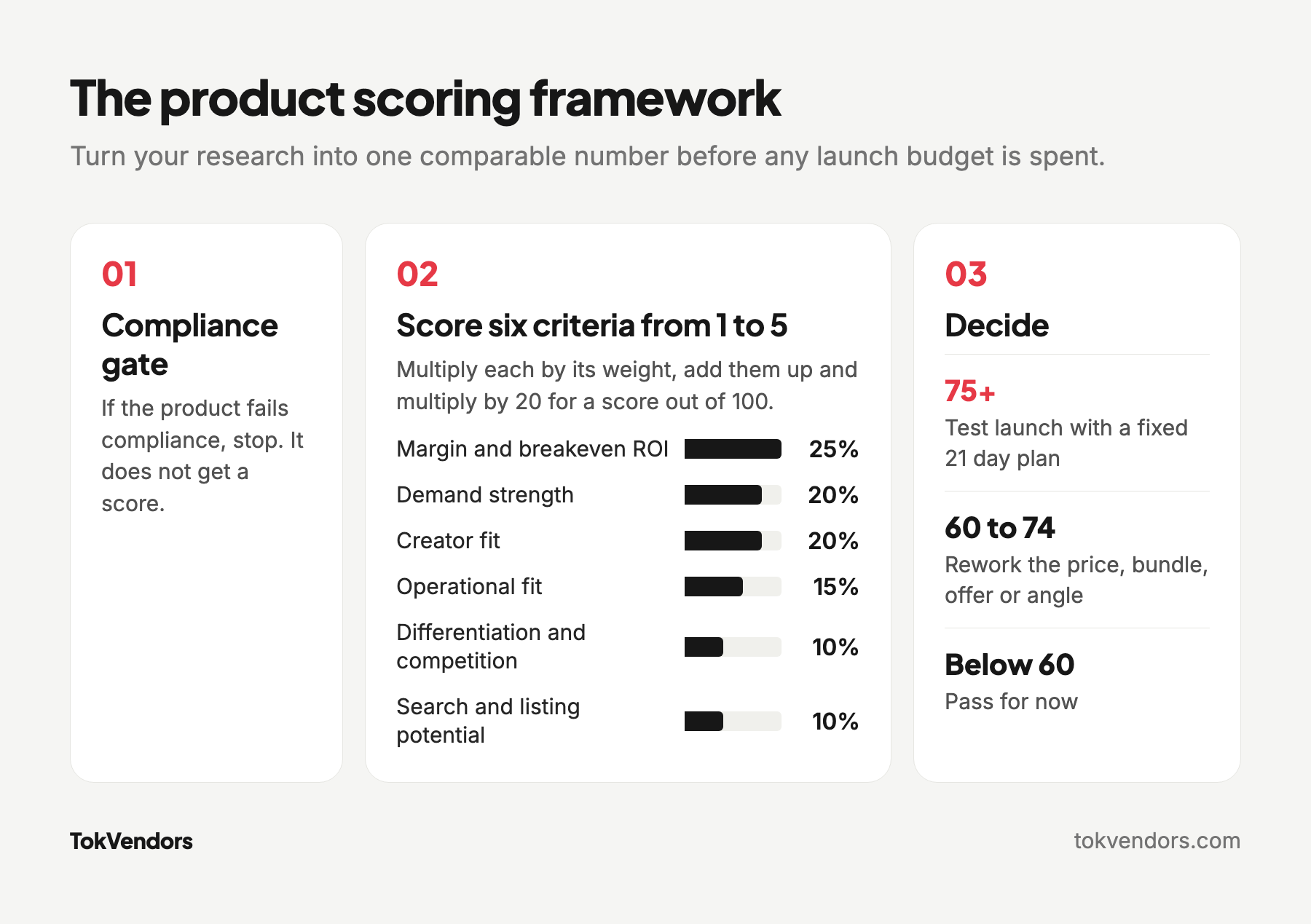
Once a product has been through all five steps, score it. The framework below turns the research into a single number so you can compare products consistently and avoid falling for the one you personally like best.
How it works
- Compliance is a gate. If the product fails compliance, stop. It does not get a score.
- Score six criteria from 1 to 5 using the descriptions in the table.
- Multiply each score by its weight, add them up, and multiply by 20 to get a score out of 100.
- Apply the decision bands: 75 or more goes to a test launch, 60 to 74 goes back for rework (price, bundle, offer or angle), and below 60 is a pass.
| Criterion | Weight | Score 1 looks like | Score 5 looks like |
|---|---|---|---|
| Demand strength | 20% | One viral video, no search volume, sales fading | Rising keyword, many creators selling, steady sales for 8+ weeks |
| Margin and breakeven ROI | 25% | Breakeven ROI above 5, landed cost above 40% of price | Breakeven ROI at or below 2.5, landed cost at or below 20% of price |
| Creator fit | 20% | Hard to film, one hook, few creators in niche | Visible in three seconds, five or more hooks, large creator pool |
| Differentiation and competition | 10% | Identical listings in a price war | Clear improvement on reviews, few strong competitors |
| Operational fit | 15% | Bulky, fragile, long lead time, high return risk | Small, durable, reliable supply, low return risk |
| Search and listing potential | 10% | No clear keyword, hard to photograph | Clear keyword, easy to show on a white background |
The weights reflect what we see decide outcomes on TikTok Shop: margin first, because it funds everything else, then demand and creator fit, because they drive volume. Adjust the weights if your situation differs. A brand with an established creator program, for example, might lower the creator fit weight.
Two illustrative scorecards
Here is how the framework separates two hypothetical products from the same home goods brand. Neither is a real client product. The point is to show the method.
| Criterion (weight) | Collapsible sink caddy | Premium ceramic pour over set |
|---|---|---|
| Demand strength (20%) | 4 | 3 |
| Margin and breakeven ROI (25%) | 4 | 2 |
| Creator fit (20%) | 5 | 3 |
| Differentiation and competition (10%) | 3 | 4 |
| Operational fit (15%) | 5 | 2 |
| Search and listing potential (10%) | 4 | 4 |
| Score out of 100 | 85 | 56 |
The sink caddy launches first because it is light, durable and cheap to sample, and its value is obvious in a short video. The pour over set is a better looking product with a loyal niche audience, but it is fragile, heavy to ship and expensive to seed, so its breakeven ROI is high. It scores below 60 and would only move up the launch order with a cheaper fulfillment route or a bundle that changes the economics.
The math for the sink caddy: (4 x 0.20) + (4 x 0.25) + (5 x 0.20) + (3 x 0.10) + (5 x 0.15) + (4 x 0.10) = 4.25, and 4.25 multiplied by 20 equals 85. The pour over set works out to 2.8, or 56. Keep your own scoring consistent and record a one line reason for each score.
Step 6: Run a test launch
A high score earns a test, not a full launch budget. The goal of a test launch is to validate demand: to learn, within a fixed time and budget, whether the product converts on TikTok Shop with real creators and real shoppers.
Before the test
- Allocate test inventory only. Set aside enough stock to cover samples plus several weeks of sales at a cautious forecast, and keep the rest working in your other channels until the product proves itself on TikTok.
- Build a complete listing. Titles, images, attributes and search terms all affect whether the product is found. Use our guide to TikTok Shop listing optimization and our breakdown of how TikTok Shop search ranks products before you go live.
- Write the creator brief. List the hooks you found in Step 3, the claims creators may and may not make, and the commission on offer.
- Set your numbers in advance. Write down the breakeven ROI, the target ROI and the kill criteria before any data arrives, so you are not tempted to move the goalposts.
During the test: a 21 day structure
| Window | Focus | What you measure |
|---|---|---|
| Days 1 to 7 | Seed samples to a targeted group of creators, post your own product videos, publish the listing | Sample acceptance, first videos posted, listing click through and early add to carts |
| Days 8 to 14 | Start a GMV Max campaign with a target ROI near breakeven, keep seeding | Orders per day, actual ROI versus target, which videos and hooks convert |
| Days 15 to 21 | Concentrate on the hooks and creators that worked, adjust price or offer once if needed | Contribution margin per order after ads, refund requests, reviews |
The exact length can stretch for slower categories, but keep a fixed end date. Open ended tests drift into open ended spending.
Go, rework or stop
At the end of the window, review the results against what you wrote down beforehand.
- Go: several creators, not one, have produced converting videos, actual ROI is at or above breakeven, refund requests are in line with your allowance, and early reviews are positive. Allocate more inventory in stages and widen the creator program.
- Rework: the product converts but margin is thin. Test a higher price, a bundle or multipack, a cheaper fulfillment route, or a lower landed cost before scaling.
- Stop: creators decline samples or post and see no sales, ROI is well below breakeven after the creative has been refreshed, or reviews flag a quality problem you cannot fix quickly. Move the remaining stock back to your other channels and test the next product on your list.
A stopped test is not a failure. It is the cheapest way to find out a product does not work on this channel. The expensive outcome is learning the same lesson after months of samples, creator outreach and ad spend.
How the framework changes for different brands
The five tests apply to every brand, but the weight of each changes with where you already sell.
For a DTC or Shopify brand, you control price, bundles and packaging, so differentiation and margin are largely in your hands. The extra risk is that your website bestseller may rely on search or email traffic that TikTok does not provide. Score creator fit honestly, and lead with the product that demonstrates best on video, even if it is not your current top seller.
For a brand already selling on Amazon or through retail partners, recognition helps demand and creator interest. The constraints are price parity with your other channels, stock allocation and other sellers who may already list your products on TikTok Shop. The margin test and a clear pricing plan usually decide the outcome.
Common product research mistakes
- Chasing a single viral video. One creator’s audience is not a market. Look for the pattern across many creators.
- Ignoring the commission layer. A product that is profitable on Shopify can be unprofitable on TikTok Shop once you pay a competitive affiliate rate.
- Treating ROI as a vanity number. An ROI of 4 sounds healthy. If your breakeven ROI is 4.2, you are losing money on every ad driven order.
- Skipping the claims check. The violation from a creator’s unapproved health claim still lands on your shop’s account health.
- Moving deep inventory to TikTok before the test. Stock committed to FBT or a dedicated warehouse makes it harder to walk away from a product that does not work.
- Testing too many products at once. Three well run tests teach you more than ten half supported ones. Creator attention and ad budget get spread too thin.
Putting it together
Winning products on TikTok Shop are found through a repeatable process, not luck. Read demand from Seller Center and the feed, run the margin test with every cost included, judge creator fit honestly, clear compliance as a hard gate, check that you can ship on time, score each product, launch the top scorers first, and validate demand with a test launch that has a fixed end date.
If you would rather have that work done for you, our product selection and listings service covers catalog scoring, margin modeling, launch order and listing build, as part of our TikTok Shop brand launch and growth work. To talk through a specific product or category, book a free strategy call with our team.
Frequently asked questions
What sells best on TikTok Shop?
Products that are easy to demonstrate in a short video and solve a problem most viewers recognize tend to do well, across categories from beauty and personal care to home and kitchen. Category alone does not make a product a winner, though. It still has to clear the margin test after referral fees, creator commission, fulfillment and ads.
How do I know which of my products will sell on TikTok Shop?
Start inside Seller Center with Product Opportunities, which lists high potential products, trending keywords and low competition categories, and with Keyword Rankings under Analytics. Match those signals against your catalog, then confirm in the app by searching each keyword, checking how many different creators sell similar products and whether sales have held up for several weeks.
What is a good profit margin for a TikTok Shop product?
There is no single right number, but the key test is breakeven ROI: price divided by what is left after product cost, fulfillment, referral fee, commission and other per order costs. As a working rule we look for a breakeven ROI of about 3 or lower, so that ads can scale the product without wiping out profit.
Can I sell supplements on TikTok Shop?
TikTok Shop’s US Prohibited Products Policy lists certain supplement, performance enhancing and research products among prohibited items, and some categories need approval or documents before you can list. Health claims are also tightly controlled. Check the current policy and your category’s requirements in Seller Center before listing, and plan creator briefs around what you can legally claim.
How many products should I launch with on TikTok Shop?
Most brands do better testing two or three high scoring products first than launching their full catalog at once. Each test needs samples, creator outreach and ad budget, and spreading those across too many products makes it hard to learn which one actually works.
Sources
- Led by U.S. sales, TikTok Shop is on track to hit $100 billion of gross merchandise value in 2026, Tubefilter (Sam Gutelle), August 6, 2026.
- How to Use Product Opportunities, TikTok Shop Seller University (US), last updated August 25, 2026.
- SEO and Discovery: Tips to Boost Visibility and Sales, TikTok Shop Seller University (US), last updated April 30, 2026.
- TikTok Creative Center, TikTok For Business.
- TikTok Shop Referral Fee Updates (2024), TikTok Shop Seller University (US), last updated May 8, 2025.
- Logistics and Fulfillment: Shipping Options, Policies, and Best Practices, TikTok Shop Seller University (US), last updated September 9, 2026.
- TikTok Shop Seller Costs in the US (2026): Fees, Creator Commissions, Fulfillment, Returns and Real Profit, FastMoss, June 12, 2026.
- GMV Max: Your TikTok Shop Growth Engine, TikTok For Business, May 13, 2026.
- Prohibited Products Policy, TikTok Shop Seller University (US), last updated October 20, 2026.
- Your Guide to Prohibited Products, TikTok Shop Seller University (US), last updated June 29, 2026.
- Product Listing Policy, TikTok Shop Seller University (US), last updated September 1, 2026.
- Fulfillment Policy, TikTok Shop Seller University (US), last updated September 28, 2026.
- FBT Rate Card and Frequently Asked Questions, TikTok Shop Seller University (US), last updated July 13, 2026.
- Customer Order Cancellation, Return, and Refund Policy, TikTok Shop Seller University (US), last updated September 28, 2026.